Showing posts with label Audi. Show all posts
Showing posts with label Audi. Show all posts
Audi to make all Chinese built models mild hybrids [video]
Audi will equip all of its Chinese made models with mild hybrid technology next year according to an interview with Mr Dominique Boesch of the GM of FAW-VW’s Audi sales unit.
The mild hybrid technology can reduce energy consumption by 3-5% said Mr Boesch. They have not made the final decision on pricing.
They are also considering applying mild hybrid technology to the imported Audi models. Mr Boesch also said that they will launch Audi Q5 coming with full hybrid technology in the near future, and then launch all-electric vehicles.
Audi has started to develop new energy vehicles since 1989. It’s also the first automaker to launch hybrid technologies, including mild hybrid and full hybrid. By 2009, Audi had launched five all-electric vehicles.
Audi A1 e-tron wins 2011 Silvretta Electric Car Rally [video]
Audi is this year’s overall winner of the second Silvretta Electric Car Rally in Austria’s Montafon region. The 2011 victory of the A1 e-tron follows the R8 e-tron’s win last year. The second Audi in the rally, a Q5 HFC with a fuel cell finished in sixth place. A total of 32 electric vehicles were evaluated.
After three days, 307 kilometers and a total altitude difference of 11,541 meters, the A1 e-tron bearing the number 206 was named the winner of the second Silvretta Electric Car Rally Montafon. The event took place from July 7-9 as part of the 14th Silvretta Classic. The name Silvretta refers to a group of mountains in the eastern Alps of Austria. The Audi A1 e-tron won against 31 competitors in a rally, that was held on highly taxing mountain roads with inclines up to 15 percent, presenting a special challenge to electric vehicles. The Audi Q5 HFC, which was also entered by Audi, achieved sixth place. This was the best final result of all cars with a fuel cell.
The A1 e-tron contains technology that Audi’s development engineers are using to study the mobility requirements for such a future-oriented concept. The technological basis includes an electric motor with a maximum output of 75 kW that is powered by a lithium-ion battery. The battery features a 12 kWh capacity and can be completely charged in 30 minutes (quick charge), or in less than three hours (standard charge). It offers a range of 50 kilometers. To prevent drivers from being stranded by an empty battery, the A1 e-tron also comes equipped with a combustion engine, which can charge the battery as needed. The one-disc rotary engine (254 cc) is located under the trunk floor; it provides 15 kW of output intended solely to charge the battery, rather than to directly power the wheels.
The A1 e-tron is designed with a local emission-free electric drive system, which is ideally suited for driving in a city.
During the rally the A1 e-tron was driven by Franciscus van Meel, Head of Electromobility Strategy at AUDI AG. Long-time Audi employee Gerhard Gruber took on the important role of co-driver. “Sending an electric car into the Alps is one of the toughest challenges you can present it with. The fact that the A1 e-tron proved so impressive here is especially gratifying to me and it proves we’re on the right track with our electric mobility approach of combining an electric motor with a combustion engine . Many thanks to our dedicated team for making our second overall victory in a row possible,” said van Meel after crossing the finish line.
Van Meel then went on to describe the rally itself: “On the first day we drove cautiously and despite a distance of just over 100 kilometers we finished with a lot of electricity left in the battery. On the second day we were better prepared and we were able to win the day; on day three we came in second, and in the end that was enough to win the overall victory. The car ran flawlessly. We’re now looking forward to the 2012 rally. We already have a few ideas about the kind of concepts we’ll enter with, of course.”
Audi Q7 2011

Striving to improve the look of the 2011 Audi Q7, British tuner Project Kahn released a comprehensive styling package for the German SUV. While there’s nothing wrong with that, we feel that an engine conversion would’ve been a welcome addition as well, justifying the aggressiveness of the wide body kit.
Taking inspiration from the firm’s previous Q7 project, the bodykit includes widened wheel arches, front wings with vents, modified bumpers and a rear roof wing. Kahn RS-X alloys round up the exterior changes.
Inside, all seven seats are clad in black perforated Nappa leather with contrasting Maranello Red stripes , while passengers sitting at the back can enjoy the entertainment package that includes two headrest-mounted 7-inch TFT screens, DVD player, wireless headsets and remote control.
The white speedometer and red rev-counter, new sill plates and aluminum pedals complete the interior upgrades.
All accessories are available as standalone pieces.
photos


The 2012 Audi Q5 hybrid quattro [video]
The First Full Hybrid in the Premium Mid-sized Class
Power like a V6, fuel consumption like a four-cylinder TDI - after three generations of the Audi duo, the Q5 hybrid quattro is the first hybrid model from Audi with two drive systems. Its gasoline engine, a 2.0 TFSI, and its electric motor have a system output 180 kW (245 hp) and 480 Nm (354.03 lb-ft) for sporty dynamics - the mean consumption in the normal cycle (NEDC) is limited to less than 7.0 liters per 100 km (33.60 US mpg).
During the development process, Audi focused on a high share of electrically powered driving. The sportiest hybrid SUV on the market covers about three kilometers (1.86 miles) locally emission-free at a speed of 60 km/h (37.28 mph), and can drive up to 100 km/h (62.14 mph) under electric power alone. With the equally powerful and lightweight lithium-ion battery and many other solutions, the Audi Q5 hybrid quattro represents the state of the art.
Performance
The 2.0 TFSI and the electric motor of the Audi Q5 hybrid are mounted directly behind one another as a parallel hybrid system - a straight-line concept with impressive efficiency. Together they have a system output of 180 kW (245 hp) and a system torque of 480 Nm (354.03 lb-ft). The new top model in the successful Q5 series sprints from 0 to 100 km/h (62.14 miles) in 7.1 seconds, while the interim sprint from 80 to 120 km/h (49.71 to 74.56 mph) is accomplished in fifth gear in 5.9 seconds. The powerful propulsion ends at no less than 222 km/h (137.94 mph).
The consumption by the Audi Q5 hybrid quattro lies under 7.0 liters per 100 km (33.60 US mpg) in the normal cycle - that corresponds to a CO2 emission of less than 160 g/km (257.50 g/mile). The 75 liter (19.81 US gallon) tank yields a reliable range comparable to that of a TDI.
The Drive
The 2.0 TFSI in the Audi Q5 hybrid quattro has a displacement of 1984 cc (121.08 cu in). Its output is 155 kW (211 hp), with the maximum torque of 350 Nm (258.15 lb-ft) permanently available at 1500 to 4200 rpm. The 4-cylinder engine combines direct injection with turbocharging - typical for the Audi philosophy of downsizing, which replaces displacement by charging. The Audi valve lift system (AVS) further increases power, torque and efficiency by switching the stroke of the exhaust valves between two stages depending on the load and rpm.
The 2.0 TFSI has been overhauled in some respects for use in the Audi Q5 hybrid. The drive of the ancillary units has been dropped, and the crankshaft bearing and fine tuning of the turbocharger have been adapted to the specific demands. A secondary air system at the cylinder head makes sure that the exhaust gas treatment cuts in particularly fast. Integrated in the engine control unit, the so-called hybrid manager controls the efficient change and smooth transitions between the operating modes, and was fully developed by Audi alone.
A largely modified eight-speed tiptronic serves the power transmission without the aid of a torque converter. Its place is taken by the disk-shaped electric motor, combined with the multi-plate clutch operating in an oil bath - it couples and decouples the electric motor and the TFSI. The innovative decoupler operates with high precision, smoothly and quickly in any situation.
The highly comfortable and fast-shifting hybrid gear unit contributes significantly to the efficiency of the Audi Q5 hybrid - its eight gears are widely spaced. When the 2.0 TFSI is turned off, an electric pump maintains the oil pressure in the hydraulic system to safeguard the convenient start-stop feature.
The Power Electronics and the Electric Motor
The power electronics, connected to the battery and the electric motor by high-voltage cabling, is located in the plenum chamber of the engine compartment. In the form of a so-called pulse-controlled inverter, the power electronics serves as a controller between the battery, which outputs direct current, and the electric motor that operates on alternating current.
Innovative technologies keep the volume and weight of the power electronics low, with cooling provided by a separate low-temperature water-filled circuit. The component includes a DC/DC converter that couples the electric consumers in the 12 V electrical system with the high-voltage network.
A so-called permanently excited synchronous machine serves as an electric motor, as a starter and - during deceleration - as a generator. It outputs up to 33 kW (45 hp) of power and 211 Nm (155.63 lb-ft). The electric motor is integrated in the cooling circuit of the engine.
The Battery
A lithium-ion battery system, weighing merely 38 kg (83.78 lb), serves as the energy store for the electric motor of the Audi Q5 hybrid quattro. The compact unit with its 26 liter (6.87 US gallon) capacity is positioned in a crash-safe area under the loading floor, with hardly any detriment to the luggage compartment. The battery consists of 72 cells; at 266 volts its nominal energy is 1.3 kWh and its output 39 kW.
The lithium-ion battery is cooled by air in two ways, depending on the requirement. At low-temperature load, it draws temperate air from the vehicle interior by way of a fan. If its temperature exceeds a certain limit, a separate refrigerant circuit is activated. It is coupled to the main climate control system of the vehicle and uses a separate evaporator.
This heavy-duty active cooling system distinguishes the Audi Q5 hybrid quattro from many other hybrid vehicles, and makes a key contribution to the high electrical availability of the hybrid system.
The Operating Modes
With its parallel hybrid system the Audi Q5 hybrid quattro can travel in five different operating modes. Driving with the combustion engine alone, with the electric drive alone or in hybrid mode is possible, as are recuperation and boosting.
At a standstill, e.g. before starting or at a traffic light, both drive sources are deactivated. In this convenient start-stop mode the climate control system remains active. Once the driver releases the brake, the Audi Q5 hybrid quattro starts rolling. It can be driven up to 100 km/h (62.14 mph) under electric power - with almost no noise or local emissions. At a constant 60 km/h the possible range is three kilometers (1.86 miles) - this high electrical share of the driving suffices for most residential areas and many urban centers.
The driver can change between three programs using a button on the center console or a selector lever. The EV characteristic map gives priority to the electric drive in the city, the D mode controls both motors for optimal consumption, and the S mode as well as the touch control gate of the tiptronic are designed for a sporty driving style.
When the driver accelerates sharply, the combustion engine serves as a power source for the drive. The electric motor is then actuated by the operating strategy in order to achieve optimal efficiency and consumption. In quick acceleration, or "boosting," the electric motor operates together with the TFSI; at full throttle in the S mode the full system output is briefly available. The hybrid drive then supplies the propulsion power of a large naturally aspirated engine, but with far more efficiency.
When the driver releases the accelerator, the electric motor acts as a generator and recovers energy. In most situations the TFSI is then decoupled from the drive system so as not to cause any loss from towing. The electricity recovered by the electric motor here and in braking is buffered in the lithium-ion battery. If the driver brakes only slightly, the electric motor performs the deceleration itself; in more forceful braking the hydraulic braking system is simultaneously activated.
Operation
The Audi Q5 hybrid comes with a new display concept, rendering the individual driving states of the hybrid drive clear-cut and tangible. Instead of the tachometer, the needle of the power meter in the dash panel insert indicates the total output of the system on a scale of 0 to 100 per cent. A second scale is divided into colored segments - their green and orange-colored sections show at a glance how the Q5 hybrid quattro is currently traveling - with a greater share of electrical power or combustion engine power. An additional instrument displays the charge level of the battery.
At the same time, the display of the driver information system and the large monitor of the MMI Navigation plus show the operating states and power flows in the hybrid system in elegant graphics with a three-dimensional effect. The MMI screen also displays differentiated consumption and recuperation statistics in easily understandable bar graphs.
The MMI Navigation plus is standard on the Audi Q5 hybrid quattro, and comes in the latest stage of evolution. The storage capacity of the hard drive is 60 GB, the menus can be selected via a state-of-the-art wizard, and the album tracks are displayed using the cover artwork. An external device such as a cell phone or player can be connected via Bluetooth, and the voice input understands town and street names in a single command. The resonant Audi sound system is also standard.
The quattro Drive and the Running Gear
The permanent four-wheel drive applies the power of both power units safely to the road in any situation. In the normal condition the sporty drive is emphasized at the rear; if need be, it transmits most of the power to the axle with the better traction. The sophisticated running gear includes many aluminum components for reduced weight. The Audi Q5 hybrid quattro may pull trailer loads of up to 2000 kg (4409 lb).
An electro-mechanical unit serves as the steering system, with a small electric motor generating the power. The system operates at high efficiency, since it need not consume any energy in straight-ahead driving. The brake servo is additionally supplied by an electric vacuum pump. A complex rule-based strategy adapts the braking to the conditions of electric driving and energy recuperation.
The Exterior
The Audi Q5 hybrid quattro is distinguished by visual features on the outside. The tailgate, the fenders and the aluminum sill panel strips bear the hybrid lettering. The radiator grill is glossy black, and the tailpipes chrome-trimmed. Polar Silver, metallic is available for the exclusive paintwork.
The 19 inch cast aluminum wheels were specially designed for the hybrid - their ten spokes resemble turbine blades. The tires are size 235/55. On request Audi supplies other wheels with 19 and 20 inch diagonals, with an S-line bumper available from quattro GmbH.
The body is unusually light in weight; the tailgate and the engine hood are aluminum. The rigid body shell incorporates hot-stamped steel at numerous places, combining low weight with very high strength.
Despite the generous level of standard equipment, the Q5 hybrid quattro with its curb weight of less than 2000 kg (4409 lb) is the lightest hybrid SUV on the world market. All its hybrid components add less than 130 kg (286.60 lb) extra weight.
The Equipment
The climate control system of the Audi Q5 hybrid was adapted to the requirements of electric driving. The compressor of the air conditioning has a high-voltage based electric drive; demand-controlled for high efficiency, the compressor ensures AC operation even when the combustion engine is shut down. An electric auxiliary heater supports the interior heating.
The Audi Q5 hybrid quattro offers almost the same equipment as its successful sister models - the model series leads the European market in the mid-sized SUV segment. The options also include sophisticated driver assistance systems. A new feature is connection to the internet via the optional Bluetooth car phone online. A UMTS model sets up the connection to special services from Google and the World Wide Web, bringing the latest news and weather information into the vehicle.
The driver can plan his or her travel route at home, save the information in an area of the internet site www.audi.com and from there download the data into the navigation system via UMTS at the start of the trip. Through the fast connection the hybrid SUV also downloads three-dimensional satellite images and aerial photos from Google Earth. They appear as bird's eye views on the monitor; the computer draws in the roads.
Another high-end feature is the WLAN hotspot, allowing connection to the internet via up to eight terminal devices. Communication occurs via the roof antenna, the connection is very stable and the reception quality excellent. Thanks to a special modulation process, UMTS data transfer occurs at speeds up to 7.2 MB per second. Encryption follows the WPA 2 standard - a very secure method.
The use of the WLAN hotspots is as easy as can be - the driver need merely insert a data-capable SIM card. At the same time the driver can pair a cell phone with the system via Bluetooth, if the phone has the SIM Access Profile. The existing mobile phone contract with a data option suffices in most cases with the result that no additional charges or separate contracts are necessary.
The Audi Q5 hybrid quattro will arrive at dealerships during 2011.
SR Auto Upgrade Package Audi R8 Supercar Valkyrie

New eye catching look dark improved by installing a matte black wrap front and tail, smoked, and sidelight. Finishing touches to the car’s exterior is to install a set of new 20 “alloy wheels One ADV7.1 Advance with a matte / gloss black lips.
SR Auto Audi R8 also received the new Valkyrie lowering springs from H & R that brought him closer to the ground. Inside, people from all over the cockpit of SR Auto adjusted by upholstering in a mixture of black leather and Alcantara with red contrast stitching and carbon fiber trim.


Avus Performance TT-RS - Dope!
The Audi TT-RS package by Berlin-based AVUS Performance has officially been introduced taking the sports car a step forward improving the power and the looks of 2.5-liter five-cylinder hot hatch! The full kit includes adjustable coilovers, gloss black 20″ Sportec Mono wheels and modification of the turbo, ECU software and the exhaust system from turbo back with racing cats. They also gave it a name; the ‘new Ur-Quattro’.


"That's DOPE"
"That's DOPE"


Seat Start Production of Audi Q3 in 2012

It seems that the VW Group’s Martorell plant in Spain will not only build the new Audi Q3, but a similar version of the compact SUV for Seat as well, according to a report from British car magazine, What Car. Industry sources told the publication that the Seat IBX crossover study shown at Geneva this year will be built in the same plant with the Audi Q3, with both models to share the same platform. The production version of the IBX is expected to be introduced next year.
The IBX is Seat's second SUV concept after the Tribu shown at the Frankfurt Motor Show in 2007. The Tribu was initially supposed to spawn a production model but the project was canned due to the grim economic outlook at the time.
Now a Seat SUV is closer than ever to reality, even though the production version could differ from the three-door IBX design study. The series production model could feature a more conventional five-door bodywork and internal combustion engines, as opposed to the concept's full-electric setup. The IBX study uses an electric motor to power the front wheels and a battery package that offers a driving range of 45 kilometers (28 miles).
The road-going model is expected to adopt a variety of TSI and TDI engines offering buyers the choice of front-wheel or all-wheel drive. At 4.26 meters long, 1.80 meters wide and 1.62 meters tall, the IBX is very close in dimensions to the Audi Q3, which measures 4.39 meters in length, 1.83 meters in width and 1.60 meters in height.
GALLERY


How It's Made: Audi R8 e-tron AWD Electric Super Car [video]
The first all-electric Audi will be built at the Neckarsulm site, with a small production run of the R8 e-tron sports car to hit the roads in late 2012. quattro GmbH is currently building the first technology platform for the electric model at the Neckarsulm plant's satellite site in Heilbronn-Biberach. Specially qualified employees are borrowing from the series production of the successful Audi R8 mid-engine sports car as they assemble the R8 e-tron at the development workshop.
"With the R8 e-tron, we are showing how inspiring electric mobility can be. Every system in this car has been tuned for maximum performance and range," says Franciscus van Meel, Head of Electric Mobility Strategy at AUDI AG. "The R8 e-tron is a very important project for Audi because the competence and experience we glean from it will later flow into the large volume production of electric automobiles." The expectation is that e-tron will become a synonym for advanced electric mobility, just as the term "quattro" today stands for pioneering all-wheel drive. "We want to be the leading premium manufacturer of electric vehicles by 2020," says van Meel.
Systematic lightweight construction is one of the key preconditions for efficiency and range in electric vehicles. The Audi development engineers are therefore drawing on one of the company's core competences for the R8 e-tron: The body is aluminum; thanks to Audi Space Frame technology (ASF), it weighs barely more than 200 kg (441 lb). The lightweight body is an important reason why the R8 e-tron weighs in at just 1,600 kg (3,527 lb).
Employees at the Pre-Production Center in Neckarsulm and quattro GmbH are currently building the first technology platforms for the electric car. "The successful production of our Audi R8 high-performance sports car has given the employees of quattro GmbH a high level of competence in the area of small production runs and sports car manufacture," explains Managing Director Werner Frowein.
The aluminum body of the technology platform is being built in conditions very close to those for volume production in the body shop for the R8 mid-engine sports car. Specific assemblies for the electric model, such as the center tunnel, are being produced by the Pre-Production Center in Neckarsulm. The R8 e-tron also goes through the coating process with the volume model. The technology platform is then sent to the satellite site in Heilbronn-Biberach for final assembly. "The production process is designed so that we can exploit synergy effects from R8 volume production," explains Frowein.
For example, the sophisticated logistics concept that supplies the R8 factory with parts is also used for the body of the technology platform. Pre-picked components are delivered to the employees in "shopping baskets." The parts are installed in the vehicles in a defined sequence in four cycles. "Small-series production places great demands on our employees," says Frowein. This is why the development workshop is staffed with experienced employees who worked in R8 series production, where they gleaned key competence in small-series production.
"The development workshop staff are specially qualified for high-voltage vehicles," explains Andreas Heine, quattro GmbH project manager for the body of the R8 e-tron. They are trained in three stages - depending on their function and technical training - to work with the high-voltage technology. The basic level is sensitization for driving and working on high-voltage vehicles. The training then builds on this to qualify the workers as electronics experts for defined activities. Finally, the extended training as Certified Electronics Specialists for Automotive Technology provides the employees with the expertise required to perform the complete range of activities associated with high-voltage models.
AUDI AG is investing more than €5 billion in the two German sites at Ingolstadt and Neckarsulm between 2011 and 2015. A majority of this investment will flow into the development of new products and into future technologies such as electric and hybrid drive systems.
Rent A Racer: Audi Race Experience Program Puts You in Race-Spec R8

The program, crafted in partnership with Team Joest, essentially allows participants to play race car driver for a day. After a series of driving lessons (including earning a current racing license), participants will field one of two Joest-owned R8 LMS cars in a VLN race on the 'Ring. Joest and Audi Sport will provide everything else needed to go racing, including tires, fuel, a pit crew, telemetry -- and, if so desired, a professional co-driver.
"For the first time, customers have the opportunity to participate in a race with a professional Audi 'factory' team without having to enter a long-term commitment, or making a high financial investment," said Klaus Demel, head of Audi's Driving Experience programs.
Demel's last point may be true -- this will be less expensive than sponsoring and running an entire race team on your own -- but we don't expect the Race Experience program to come cheap. Audi hasn't talked pricing, but seeing as there are more costs to amortize than the company's Sportscar Experience (which runs roughly $3500 for a two-day program), we know this experience will carry a lengthy bill.
If cost is no object to you, add this to your bucket list -- and quickly. Team Joest is only running these cars in six VLN races at the Nürburgring, so despite the high prices, expect openings to disappear quickly.


Source: Audi
O.CT Brings 420 Ponies to the Audi TT RS

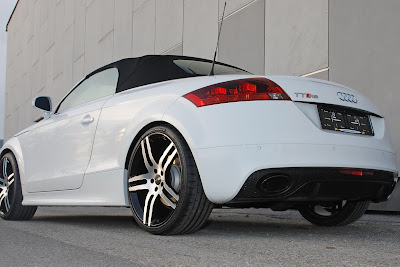
Need to add a some extra oomph to your Audi TT RS Roadster (or coupe, for that matter)? No worries, there's an army of tuners out there that will most gladly up the performance ante of your car. One of the latest tunes for Ingolstadt's TT RS model comes from O.CT which has developed a sport package that includes an engine kit, suspension upgrades and a set of alloy wheels.
Thanks to a new custom exhaust system, an ECU mod and some fiddling around with the turbo system, O.CT pushes output from 340HP to 450Nm to 420HP and 570Nm. The conversion also includes a KW coilover suspension and a set of lightweight 20-inch alloy wheels.
photos



Audi A3 e-tron Sedan Concept Shown @ Shanghai Auto Show [video]
Audi has unveiled its latest e-tron concept in Shanghai this week, carrying over much of the earlier A3 Sedan concept's styling but swapping in a petrol-electric hybrid drivetrain under the skin.
Replacing the A3 Sedan concept's petrol-only 300kW 2.5 litre four-cylinder engine is a turbocharged and direct-injected 157kW 1.4 litre TFSI petrol engine, mated to a 20kW electric motor.
Combined with Audi's seven-speed S tronic automatic transmission, the A3 e-tron concept is capable of a 0-100km/h sprint in 6.8 seconds, on its way to a top speed of 231km/h.
Power for the electric motor is supplied by a 12kWh lithium-ion battery park, and in electric-only mode, the A3 e-tron offers a driving range of up to 54 kilometres.
The unveiling of Audi's latest in a growing line of e-tron concepts follows the reveal last week of the A3 e-tron hatch prototype, based on the current model and featuring an all-electric drivetrain.
The all-new A3 is expected to make its international production debut in the second half of 2012, in both sedan and hatch form.


Subscribe to:
Posts (Atom)

