Blog Archive

Showing posts with label Volvo. Show all posts

Volvo announces three range extended EV concepts


Volvo Car Corporation develops Range Extenders for electric cars - adding 1,000 km extra range

Volvo Car Corporation is now taking the next step in the company's electrification strategy by producing test cars with Range Extenders - electric cars that are fitted with a combustion engine to increase their effective range.

The projects, supported by the Swedish Energy Agency and the EU, encompass three potential technology combinations. Tests of the various concepts will get under way in the first quarter of 2012.

"This is an exciting expansion of our increasing focus on electrification. Battery cost and size mean that all-electric cars still have a relatively limited operating range. With the Range Extender, the electric car has its effective range increased by a thousand kilometres - yet with carbon dioxide emissions below or way below 50 g/km," says Derek Crabb, Vice President Powertrain Engineering at the Volvo Car Corporation.

The company's technological developments in this area currently encompass three different technology combinations, with three-cylinder petrol engines being installed to complement electric drive to the front wheels. All the variants feature brake energy regeneration. The engines can run on both petrol and ethanol (E85).
Two of the solutions are based on the Volvo C30 Electric. In both cases, the standard battery pack has been somewhat reduced in size to make room for the combustion engine and its fuel tank.

Technical concept I: Volvo C30 with series-connected Range Extender

This is based on a C30 Electric with a three-cylinder combustion engine producing 60 horsepower (45 kW) installed under the rear load compartment floor. The car also has a 40 litre fuel tank.
The combustion engine is connected to a 40 kW generator. The power it generates is used primarily to drive the car's 111 horsepower (82 kW) electric motor, but the driver can also choose to let the generator charge the battery, thus increasing the car's operating range on electricity. The Range Extender increases the electric car's range by up to 1,000 km - on top of the 110 km range provided by the car's battery pack.
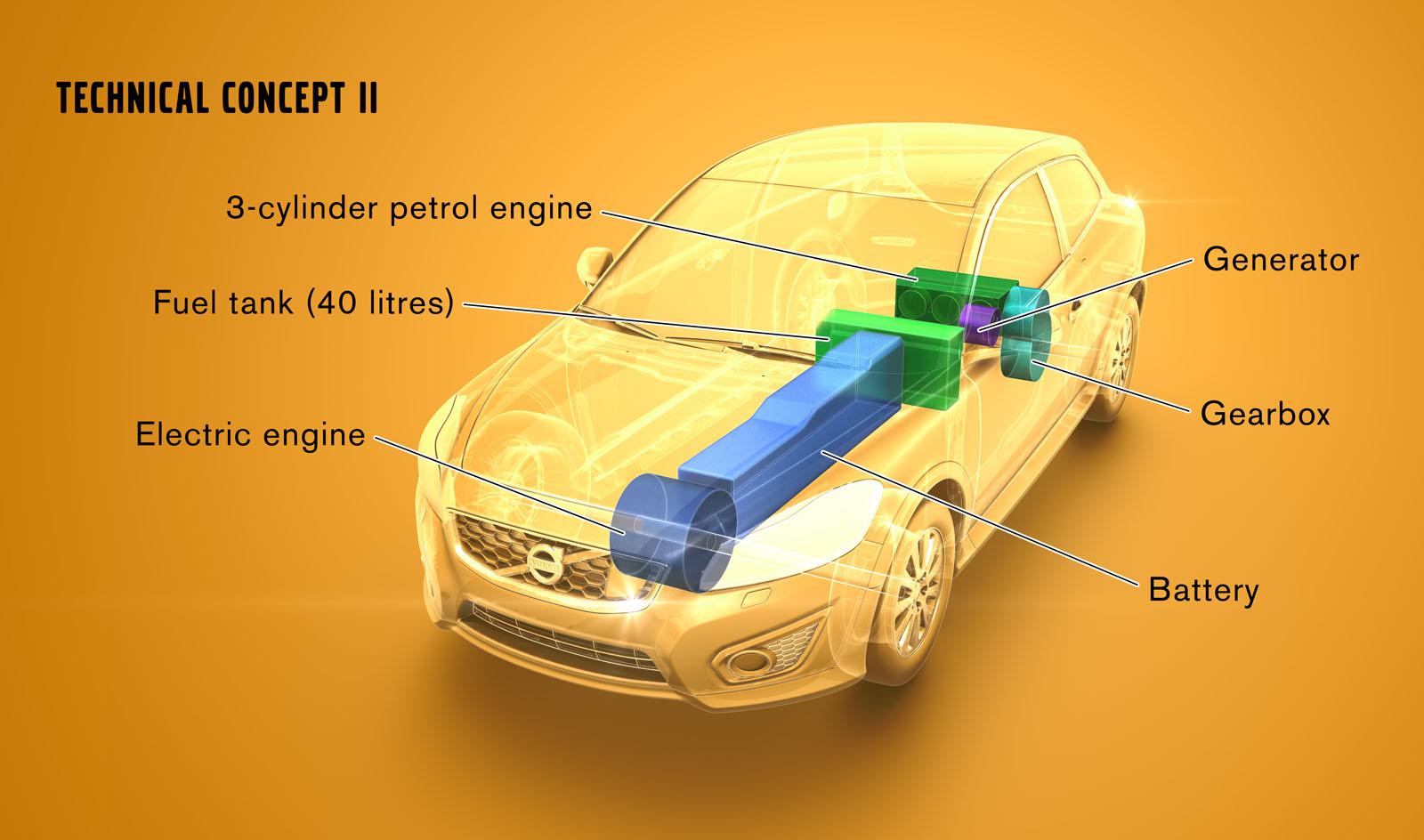

Technical concept II: Volvo C30 with parallel-connected Range Extender

Here the car gets a more powerful three-cylinder combustion engine at the rear and a 40 litre fuel tank. The difference between this and the first solution is the parallel connection, whereby the turbocharged 190 horsepower engine primarily drives the rear wheels via a six-speed automatic transmission. This gives a better fuel efficiency rating when driving with the combustion engine cruising on the highway. Via a 40kW generator the battery can also be charged to give the car increased range on electricity alone.
Here too the electric motor is a 111 hp (82 kW) unit. The two power sources give the car more than 300 hp in total, and acceleration from 0-100 km/h of less than six seconds.
The Range Extender increases the electric car's range by more than 1,000 km - in addition to the range of up to 75 km provided by the car's battery pack.


Technical concept III: Volvo V60 with parallel-connected Range Extender

This is a solution whereby the entire drive package is installed under the bonnet at the front. The 111 hp (80 kW) electric motor is supplemented with a three-cylinder petrol turbo engine producing 190 hp (140 kW), a two-stage automatic transmission and a 40 kW generator. Power from the combustion engine drives the front wheels via the gearbox and recharges the battery pack whenever needed.

Up to 50 km/h, the car is always powered solely by electricity. The combustion engine is activated at higher speeds. What is more, it charges the battery pack when its charge drops below a predetermined level.

The battery pack is located under the rear load floor and it gives the driver a range of 50 km on electricity alone. The car also has a 45 litre tank for petrol or E85.
With this technology, the Range Extender increases the car's total range by more than 1,000 kilometres.

CO2-lean driving pleasure and comfort

The series-hybrid Range Extender in the C30 is part of an EU project in which the Volvo Car Corporation is the only car manufacturer among eight partners. The company's two parallel-hybrid Range Extender solutions are being developed with a grant of SEK 10.8 million (EUR 1.2 million) from the Swedish Energy Agency.

"These three projects allow us to evaluate the Range Extender's various possibilities. As with the C30 Electric and V60 Plug-in Hybrid, the goal is to make the cars exceptionally CO2-lean without compromising on customer requirements such as comfort, driving pleasure and practicality," explains Derek Crabb.

Volvo C30 Electric production begins deliveries start August 2011 [video]


Volvo has begun production of its C30 Electric, and initial deliveries to leasing customers, mainly companies, authorities and governmental bodies is expected to begin from August.

The car, which will be delivered to leasing customers throughout Europe including those in Sweden, Belgium, the Netherlands and Norway – is built on the regular assembly line in the Ghent factory and then transported to Goteborg for installation of the motor, batteries and other model specific electronics.

The C30 Electric has an operating range of up to 150 kilometres per full charge – charging can be done via a regular household power socket, with a full recharge taking about seven hours. The car has a 130 kph top speed and does the 0-100 kph sprint in 10.9 seconds.

Tests on a fleet of about 50 cars have been conducted since September 2010, mainly internally at the Volvo Car Corporation. In terms of production, about 250 cars will be built by end 2012, possibly more if market interest takes off, the company says.

Volvo Going Racing with Rear-Drive Volvo S60

Now that the production 2011 Volvo S60 has launched, Volvo is turning its attention to the race track. The Belgian arm of the Swedish automaker outlined the first details of its entry into 2010 the Belgian Touring Car Series, which begins April 11.

The BTCS is a six-race endurance series. Most races consist of two 90-minute heats, while a 12-hour race occurs at legendary Spa-Francorchamps. Competition includes BMW, Audi, Jaguar, and Volkswagen.


The racing S60 falls under Silhouette S1 specification, meaning all cars must use a tubular chassis, identical front and rear suspension, aerodynamics, and an engine no larger than 3500 cubic-centimeters.

The team's goal, including drivers Vincent Radermecker and Eric Van De Poele, is to get acquainted with the new car, per manager Thomas Neri. "Our main objective is to get up to speed and to compete well in the various heats. Next season we hope to put our own in-house developed engine in the car," he said in a press release.

Volvo S60 BTCS Silhouette S1 Specs:
Chassis: Tubular frame
Layout: Mid-engine, rear-drive
Drivetrain: 3500cc V-6, six-speed sequential transmission
Output: 410 hp, 304 lb-ft
Suspension, f;r: Independent, 3-way adjustable shocks; independent, 3-way onboard adjustable shocks
Brake, f;r: 15.0-in rotor, 6-piston caliper; 14-in rotor, 6-piston caliper
Wheels, f;r: 10 x 18-in; 12 x 18-in
Tires, f;r: Michelin 27/65/18; 30/65/18

In related news, Polestar Performance, the team behind Volvo's Swedish Touring Car Team, has announced a road car project based off the C30. Details are slim, but the racing team says the C30 will boast 395 horsepower, all-wheel-drive, and aerodynamic tricks used in racing.
"Polestar has probably spent more time than anyone else in the world to get speed out of the C30, and this time we can realize ideas without being halted by specific race regulations," said Jan Andersson, team technical director.

The project will debut at the Gothenburg auto show between April 22 and 25. Fans can follow project updates at Polestar's Web site.


-By Carlos Lago

Volvo Releases More Details for 2012 Volvo C30 Electric [video]


With the introduction of the 2012 Volvo C30 Electric to take place later this year in Europe, Volvo has announced some of the finer details for the all-electric, zero-emission hatchback. Volvo estimates that within 10 to 15 years, electric cars will account for up to 10 percent of new vehicles in the European Union, but even though its is launching a fleet of 250 test vehicles, it has yet to announce any timeline for mass production, but it did say that it expects an all-electric driving range of 93 miles with a top speed of 80 miles per hour.

Volvo uses a water-cooled electric motor mounted under the hood that produces 111 horsepower and 162 lb-ft which gets its electricity from a 24 kWh lithium-ion battery pack that can be charged in as little as six hours depending on the power source. The battery pack is mounted under the passenger compartment where the conventional C30’s fuel tank goes adding a hefty 616 pounds to the EV’s curb weight, and that added weight hampers the car’s performance. Even though EVs are known for their instant torque, the Volvo C30 Electric isn’t likely to be too thrilling off the line with Volvo claiming acceleration from zero to 70 kilometers per hour (roughly 44 mph) in 6.5 seconds.

Cold-weather driving has proven to be one of the ways most EVs are being tripped in terms of their expected range, so Volvo developed the C30 Electric with a climate control system in attempts to combat this problem. Instead of using the batteries to power a heating source in wintry weather, the C30 Electric uses a heater that is powered by bio-ethanol and in this instance the C30 Electric would create some emissions. Before the “Volvo lied” crowd gets too rowdy, there is also a heating element that is battery powered, but, if used, it would reduce the overall driving range. The fuel tank measures just 3.8 gallons and can be refueled from the same hole used for the fuel tank on the non-electric C30.

“The driver can program and control the climate unit to suit the trip. Ethanol is the default mode that is used when the battery capacity is needed for driving as far as possible,” said Lennart Stegland, director of Volvo Cars' Special Vehicles. “However, on shorter distances electricity can be used to power the climate system”
To maximize the driving range, Volvo engineered the C30 Electric down to the fine details such as weight-saving wheels and aerodynamic improvements which are some of the components that give this car a unique exterior styling. The biggest visual change to the C30 Electric are the exclusive, lightweight wheels that help shave 24 pounds from the C30’s curb weight and the new grille that houses the electrical connection, but the underside of the car is also slightly different as well with added panels for improved aerodynamics. All C30 Electric feature the sportier R-Design body kit, and the initial run of cars will feature a Cosmic White color with a light Ornioco Blue accents around the lower edges of the car and on the mirrors.

In true Volvo style, the automaker has designed the EV components to be as safe as possible especially with the batteries, combustible fuel and Volvo’s reputation for safety. The main differences on the C30 Electric are a retuned stability control system for the added vehicle weight and aluminum rear brake discs that further reduce weight and last longer since the brakes are used less with the regeneration system. Volvo even had a crash-tested C30 Electric prototype on display earlier this year at the North American International Auto Show in Detroit.

The Volvo C30 Electric will initially launch in Europe in the second half of this year, but China and the United States will likely get the cars during the 2012 calendar year.

"We have received very positive signals from the market so far. Fleet customers such as authorities and companies will lease most of the initial 250 cars,” said Stegland. “The cars will go to Sweden, Norway, Belgium, the Netherlands, France, Germany, U.S.A. and China. If demand continues to remain high, we will increase our production."

Volvo is among a handful of automakers introducing a mainstream EV going up against the likes of the Nissan Leaf, Mitsubishi i-MiEV and even the Chevrolet Volt and Opel Ampera. Like some of its current EV rivals, certain functions of the C30 Electric (such as the HVAC system) can be preprogrammed to come on at a certain time or remotely operated using a computer or smartphone.

Heico Sportiv Volvo XC90


Heico new kit for the XC90 is purely aesthetic at the moment but in the near future they could be a power / performance upgrade. Heico’s bodykit for the Volvo XC90 has a new front bumper replaced with a stainless steel stays, the mass of central and lateral parts produced. The Heico Volvo XC90 also comes with new side sills, in the workshops and a new rear apron with integrated parking sensors.

According to Heico Sportiv's CEO Holger Hedtke, "Our new bodykit intends to give dealerships an attractive opportunity to offer additional buying incentives. Around the globe, the Volvo XC90 has an unwavering fan club that will certainly applaud the modern, self-assured design from Heico Sportiv.

The Heico Sportiv exterior kit can be fitted to all Volvo XC90s produced from 2007 onwards. The package will be available for purchase starting from May. Before the pack arrives, we’re inviting you to enjoy the gallery below, which also includes imaged from its development phase.


Volvo XC90 by Heico SportivVolvo XC90 by Heico SportivVolvo XC90 by Heico SportivVolvo XC90 by Heico SportivVolvo XC90 by Heico SportivVolvo XC90 by Heico SportivVolvo XC90 by Heico SportivVolvo XC90 by Heico Sportiv


Press Release

Volvo XC90 reloaded


Due to its continued success, Volvo will be retaining the XC90 in its production program. HEICO SPORTIV is revitalizing the SUV's design and is now presenting an entirely new bodykit.

"There's life in the old dog yet!" could be the caption beneath the current Volvo XC90, considering the model has been on the market since 2003. Given the constant level of demand for this vehicle, however, Volvo has chosen to continue producing the Sweden SUV until model year 2014.


HEICO SPORTIV saw this as an advantageous opening and seized the opportunity to take an extremely novel step: the development of an entirely new bodykit. "Our new bodykit intends to give dealerships an attractive opportunity to offer additional buying incentives," explains HEICO SPORTIV CEO, Holger Hedtke, adding: "Around the globe, the Volvo XC90 has an unwavering fan club that will certainly applaud the modern, self-assured design from HEICO SPORTIV."

Complete and perfectly integrated.
The Volvo XC90 by HEICO SPORTIV has a perfectly integrated design. The six-part bodykit picks up on the current Volvo XC60's dynamic use of forms, fitting like a custom-made suit. The one-piece front skirt replaces the series-produced central and side panels and has a stainless steel stay located in front of the cooling air outlet. The side skirts are mounted on top of the original parts, with the rear skirt fully replacing the standard one. And - typical for HEICO SPORTIV - the rear skirt accommodates the four-pipe exhaust system with oval chrome end tips which can be extended optionally with a stainless steel inlay.

All plastic parts are produced from high quality PUR-R-RIM and are easy to fit. The HEICO SPORTIV Bodykit will be available from May 2011 for the XC90 from model year 2007 onwards and can be delivered for all engine versions.

Fullycharged Volvo C30 EV Crash Test [video]


Robert Llewellyn was invited on a PR trip to visit Volvo in Sweden and have a look at how they crash testing the electric version of the Volvo C30.

2010 Volvo Sport Cars Air Motion Concept

2010 Volvo Sport Cars Air Motion Concept
At the Los Angeles Design Challenge Competition, Volvo took the open-air experience at a whole new level with its ‘lighter than a Formula 1 racing car’ study project – the Volvo Air Motion. Besides its strong yet ultra-light body structure, the Air Motion concept cars vehicle further adds to its superlatives eco-friendliness, as it is not using a single drop of gasoline while driving wild.
Volvo Air Motion is a sports cars that runs on powerful, yet simple compressed air motors that, unlike an internal combustion engine, cools down under load rather than heat up. The air tank is centrally mounted and receives compressed air through wind-powered air replenishment sites that float 1000ft in the air. Its beautiful Scandinavian body is designed like a clam shell and sculptured from ultra light carbon fiber.
2010 Volvo Sport Cars Air Motion Concept
Tipping the scales at under 1,000 pounds (453 kg), the Volvo Air Motion Concept is lighter than a Formula One car and employs a similar open-wheel configuration.
2010 Volvo Sport Cars Air Motion Concept
The 2010 Volvo Sport Cars Air Motion Concept was developed around the idea that minimizing the weight and complexity means maximizing driving enjoyment. Volvo built the cars with fewer components and replaced the heavy internal combustion engine with powerful, yet simple, compressed air motors.
To compress the air needed for the centrally mounted air tank, Air Replenishment Sites are used. Powered by air turbines floating 1,000ft in the air they harness the power of the wind and convert it to electricity to provide the compression. The motors cool down with increased load, instead of heating up, which eliminates the need for cooling systems. The chassis, interior and suspension employ an integrated design which brings a notable contribution to the lowered weight.
Aimed at the driving enthusiast, by a company synonymous with safety and environmental care, the Volvo Air Motion Concept demonstrates the beauty and purity of Scandinavian design and delivers a guilt free, raw driving experience.
2010 Volvo Sport Cars Air Motion Concept

2010 Volvo Sport Cars Air Motion Concept

2010 Volvo Sport Cars Air Motion Concept
At the Los Angeles Design Challenge Competition, Volvo took the open-air experience at a whole new level with its ‘lighter than a Formula 1 racing car’ study project – the Volvo Air Motion. Besides its strong yet ultra-light body structure, the Air Motion concept cars vehicle further adds to its superlatives eco-friendliness, as it is not using a single drop of gasoline while driving wild.
Volvo Air Motion is a sports cars that runs on powerful, yet simple compressed air motors that, unlike an internal combustion engine, cools down under load rather than heat up. The air tank is centrally mounted and receives compressed air through wind-powered air replenishment sites that float 1000ft in the air. Its beautiful Scandinavian body is designed like a clam shell and sculptured from ultra light carbon fiber.
2010 Volvo Sport Cars Air Motion Concept
Tipping the scales at under 1,000 pounds (453 kg), the Volvo Air Motion Concept is lighter than a Formula One car and employs a similar open-wheel configuration.
2010 Volvo Sport Cars Air Motion Concept
The 2010 Volvo Sport Cars Air Motion Concept was developed around the idea that minimizing the weight and complexity means maximizing driving enjoyment. Volvo built the cars with fewer components and replaced the heavy internal combustion engine with powerful, yet simple, compressed air motors.
To compress the air needed for the centrally mounted air tank, Air Replenishment Sites are used. Powered by air turbines floating 1,000ft in the air they harness the power of the wind and convert it to electricity to provide the compression. The motors cool down with increased load, instead of heating up, which eliminates the need for cooling systems. The chassis, interior and suspension employ an integrated design which brings a notable contribution to the lowered weight.
Aimed at the driving enthusiast, by a company synonymous with safety and environmental care, the Volvo Air Motion Concept demonstrates the beauty and purity of Scandinavian design and delivers a guilt free, raw driving experience.
2010 Volvo Sport Cars Air Motion Concept

GETRAG equips the Volvo C30 Drive Electric with powertrain unit


GETRAG has secured a contract from Volvo to supply the electric drive unit 1eDT240 for the electric version of the Volvo C30.

Volvo Car Corporation is building up a small fleet of the vehicle in the course of this year. This test fleet serves for research purposes, aiming for a high environmental profile, and will use a leasing model to selected customers such as companies and governmental bodies. So far, the car is not available for end-customers.

Currently the highest-performance single-motor drive unit 1eDT240 in the group's product portfolio uses a permanently excited synchronous machine with a maximum output of 82 kW (at a nominal voltage of the electric energy storage device of 360 volt). The coaxial drive unit was specifically developed for the demanding requirements of virtually silent purely electric driving. It is characterized by the partial integration of the electric motor and therefore for its very compact design.

The development process placed particular emphasis on noise-optimized gearing and very high efficiency. The maximum drive torque of 2,400 Nm offers sufficient traction force to make even sporty acceleration possible. The 1eDT240 drive unit benefits from use of large-scale series production parts from the GETRAG modular system.

If required, the 1eDT240 can also be equipped with a higher-performance electric motor delivering up to 145 kW. It can be supplied in three different transmission ratios.

"The 1eDT240 drive unit can be fitted in a wide variety of electric and hybrid vehicles with front or rear-wheel drive thanks to its compact, versatile design. This unit can cover the entire range from city to sports car and even light truck applications", commented Alexander Strube, Chief Program Engineer for E-Drive at GETRAG.

GETRAG has been active in the field of electric drive systems since 1992 and has already received several series production orders and a large number of development contracts in this area. Several electric-drive test fleets e.g. of the BMW MINI, the Mercedes-Benz B-Class F-CELL and the Necar Series, have already been equipped with GETRAG drive technology.

Volvo Developing World’s Fastest Hybrid Truck


After improving a previous world speed record for the standing kilometer in June 2010 with a diesel model, Volvo Trucks is now developing a new diesel-electric hybrid version called "Mean Green" to claim the title of the World's Fastest Hybrid Truck in spring 2011.

A well known Swedish truck racing ace, Boije Ovebrink, is going to be the one to drive the hybrid and he's already very confident of a positive outcome. "I'd go so far as to say that 'Mean Green' is the world's fastest hybrid truck," Mr. Ovebrink said.

"I started building the truck from two half frames that had been earmarked for the scrap yard and the American VN cab came from a crash-tested chassis whose cab was totally intact," explains Volvo engineer Olof Johansson.

Conventional oomph comes from a 16-liter Volvo engine, fitted with Volvo Penta twin turbos that increase peak output to a whopping 1,900 hp (1,417 kW). The electric motor adds another 200 hp (149 kW) and 1,000 Nm (738 lb-ft) of torque to this explosive cocktail and can interact with the driven wheels through a modified I-Shift automated gearbox.

Weight reduction is crucial when you want to set these kinds of records, so Volvo engineers milled a new, 43 kg (95 lbs) lighter front axle and also removed the gear set for the first gear, as it was rendered useless by the huge amount of torque. That shaved off another 7 kg.

Even Mr. Ovebrink takes part in these weight-saving efforts. " They made me promise to lose 20 kilos and, so far, I'm half-way to my target," said the truck racing driver.

The first test runs will take place this month, so we'll be keeping an eye open for any updates

Volvo confirm C30 DRIVe Electric will go into production in early 2011


In a press conference at Paris Motor Show on Thursday September 30, Stefan Jacoby, President and CEO of Volvo Cars stated that the future for Volvo lies in electric cars.

"We will set a standard in the industry," Jacoby said, revealing that the Volvo C30 DRIVe Electric will go into production in 2011.

Le Mondial Automobile in Paris is the first international motor show for Stefan Jacoby in his new position. He joined Volvo Cars as President & CEO on 16 August.

In Paris, Volvo Cars displays the new sports wagon V60 to the public for the first time, alongside with the sporty R-Design version of both the S60 sedan and the V60.

During the press conference in the Volvo stand, Stefan Jacoby emphasised the importance of electrification. Present in the stand is the Volvo C30 DRIVe Electric, a sporty car that runs purely on electricity and has a range of 150 kilometres on a single charge.

The C30 DRIVe Electric will go into production in early 2011 and run in test fleets in Europe, China and the US.

Stefan Jacoby also stated that Volvo Cars will have a plug-in hybrid on offer in 2012, combining an electric power with a diesel hybrid power train. The Volvo plug-in hybrid will have ultra low CO2 emissions, below 50 grams CO2/km.

"We move into the future with the aspiration to design vehicles with minimised environmental impact, as well as the ambition to produce the world's safest cars," Stefan Jacoby said.


.

Volvo C30 Electric - Battery Crash Test


Here's a Youtube video we found where Volvo crash test a C30 EV to make sure the battery is in a safe position.

The battery is marked with green to clearly show its location under the car.

This crash test was performed at 30 mph (approximately 48 km/h).

Highspeed material is filmed in 1000 fps.


.

Tomorrow's Volvo: body panels serve as the car battery


Imagine a car whose body also serves as a rechargeable battery. A battery that stores braking energy while you drive and that also stores energy when you plug in the car overnight to recharge. At the moment this is just a fascinating idea, but tests are currently under way to see if the vision can be transformed into reality. Volvo Cars is one out of nine participants in an international materials development project.

Among the foremost challenges in the development of hybrids and electric cars are the size, weight and cost of the current generation of batteries. In order to deliver sufficient capacity using today's technology, it is necessary to fit large batteries, which in turn increases the car's weight.

Earlier this year, a materials development project was launched by Imperial College in London that brings together nine European companies and institutes. Volvo Cars is the only car manufacturer participating in the project. With the help of 35 million SEK (approx. 3.5 million EURO) in financial support from the European Union (EU), a composite blend of carbon fibres and polymer resin is being developed that can store and charge more energy faster than conventional batteries can. At the same time, the material is extremely strong and pliant, which means it can be shaped for use in building the car's body panels. According to calculations, the car's weight could be cut by as much as 15 percent if steel body panels were replaced with the new material.

Volvo Cars contributes its expertise

The project will continue for three years. In the first stage, work focuses both on developing the composite material so it can store more energy and on studying ways of producing the material on an industrial scale. Only in the final stage will the battery be fitted to a car.

"Our role is to contribute expertise on how this technology can be integrated in the future and to input ideas about the advantages and disadvantages in terms of cost and user-friendliness," says Per-Ivar Sellergren, development engineer at the Volvo Cars Materials Centre.

Initially, the car's spare wheel recess will be converted into a composite battery.
"This is a relatively large structure that is easy to replace. Not sufficiently large to power the entire car, but enough to switch the engine off and on when the car is at a standstill, for instance at traffic lights," says Per-Ivar Sellergren.

Immense interest in the project

Many people have visited the Imperial College website, which contains information about the project, and have seen the YouTube. Per-Ivar reads the visitor comments with immense interest.

"Almost daily I read new ideas about how this technology could be used or further developed. The potential is enormous and it's great that so many people are interested," he says.

If the project is successful, there are many possible application areas. For instance, mobile phones will be able to be as slim as credit cards and laptops will manage longer without needing to be recharged.


.

2011 Volvo S60 All New

2011 Volvo S60 All New

When the Volvo S60 debuted 10 years ago with its muscular fenders and sweeping roof line, it was a radical, refreshing departure from the dowdy box on wheels it replaced. But 10 years is a long time, and this model has been desperately in need of a redesign for a few years now. So the 2011 Volvo S60 finally represents a makeover, and the resulting car once again claims the glamour standing in the company's lineup.

Based on a shortened S80 platform, the new midsize S60 remains on the small side of the midsize car spectrum. However, it's 1 inch longer overall, 2 inches wider and has a 2.3-inch-longer wheelbase than before. Inside, you'll find Volvo's understated but classy design aesthetic that includes the trademark "floating" center stack control panel. Under the skin, the 2011 Volvo S60 promises a more engaging drive thanks to quicker steering and a choice of suspension options that include a more firmly calibrated sport version dubbed "Dynamic" as well as Volvo's adaptive "FOUR-C" setup.

The company known for building safe cars hasn't forgotten its roots. As such the 2011 S60 boasts Volvo's latest advance in safety technology called Pedestrian Detection with full auto brake. This system has the ability to detect pedestrians who are at least 31 inches tall, then can apply full braking power to avoid a collision even if you take no action. At lower speeds (around 21 mph or less) it can bring the car to a full stop, while at higher speeds it slows the S60 to lessen the severity of a potential impact. You can, of course, take back control of the situation by steering around the danger.

The 2011 Volvo S60 will initially only be available in the top-of-the-line, highest-performing "T6" form, meaning it will sport a 300-horsepower turbocharged inline-6 and all-wheel drive. Later in the model year a front-wheel-drive T6 will become available, as will the T5 trim, the latter having the brand's familiar turbocharged inline-5 making 227 hp.

Despite Volvo's claim that the 2011 S60 is the sportiest sedan it has ever sold, it still doesn't exactly match the fun of a BMW 3 Series or Infiniti G37. Yet many buyers are more interested in the sort of comfortable, quiet and refined ride offered by an Audi A4 or Mercedes-Benz C-Class, and for them the S60 should be a smart, stylish alternative. It took awhile, but Volvo is finally back in the game.


The 2011 Volvo S60 is a midsize luxury sport sedan currently available in a single T6 trim level.The S60 T6 comes with all-wheel drive, a sport-tuned suspension, 18-inch alloy wheels, front sport seats (eight-way power with memory settings for the driver), leather upholstery, aluminum interior trim, a tilt-and-telescoping steering wheel, dual-zone automatic climate control, an auto-dimming rearview mirror, Bluetooth and an eight-speaker audio system with a single-CD player, satellite radio, HD radio, an iPod/USB interface and an auxiliary audio jack.Going for the optional Premium package gets you adaptive xenon headlights, a sunroof and a power passenger seat. 


The Multimedia package upgrades the S60 with a 12-speaker premium sound system, a rearview camera and navigation system with real-time traffic updates. The Climate package adds heated front seats, heated windshield washer jets, rain-sensing wipers and an interior air quality system, while the Technology package includes adaptive cruise control, collision warning with auto brake, pedestrian detection, lane departure warning and driver alert control.Individual options include the FOUR-C adaptive suspension, a more compliant "Touring" suspension (no extra charge), 17-inch wheels, front and rear parking sensors, blind spot alert, keyless ignition/entry and a rear-seat entertainment system with dual display screens.

The 2011 Volvo S60 T6 has a turbocharged 3.0-liter inline six-cylinder that makes 300 hp and 325 pound-feet of torque. A six-speed automatic transmission with sport and manual shift modes is standard, as is all-wheel drive.Though we haven't yet track-tested the S60 T6, Volvo claims a 6.2-second 0-60-mph time, which feels accurate based on our seat-of-the-pants impressions. Fuel economy is average compared with other six-cylinder models in this class, with EPA mileage estimates of 17 mpg city/26 mpg highway and 21 mpg combined.


Interior materials in the 2011 Volvo S60 are on par with the rest of the entry-level luxury sedan class. You may not care for the heavier graining on the dash and doors, but there's no denying that the leather, vinyl and plastic used in this cabin are of solid quality. Volvo offers a different take on the expected wood and metal accents that give the S60's cabin more personality than most rivals.

The straightforward dual-temperature adjustment dials and the "mode man" pictogram make adjustments to the climate control system intuitive. The audio system is fairly easy to use, too, though the array of small audio buttons is starting to look dated. The available DVD-based navigation system thankfully does away with the complicated back-of-the-steering-wheel controls seen on previous Volvos and adopts a more conventional dial-type controller. In practice, this interface works fine, though Volvo's navigation software still feels a few years behind the times.


As one would expect in a Volvo, the front seats are excellent in terms of long-trip comfort and proper support. Unfortunately, the backseat isn't quite as accommodating. The seats themselves are supportive, but legroom and foot room are tight for adults over 5-foot-8. Most competitors are slightly more accommodating.


Trunk capacity, at 12 cubic feet, is a bit small for the class as well, but a low liftover height makes it easy to access the space. Both the rear seats and the front passenger seat fold down, and there's a separate ski pass-through.


2010 Volvo XC90

2010 Volvo XC90


Volvo does things a little differently from other premium brands in the automotive world. For this Swedish manufacturer, safety and kid-friendliness are just as important as luxury amenities and driving performance, and in no vehicle is this more apparent than the Volvo XC90, a midsize seven-passenger SUV.

Innovative safety features aside, the XC90 is merely adequate relative to the premium midsize SUV competition. Zestier performance is available elsewhere, as are more cavernous cargo holds. With more and more modern competitors measuring up to Volvo's high safety standards, the aging XC90 isn't the slam dunk for families that Volvo products used to be. It remains capable, though, and arguably safer than ever thanks to some new tricks.


The Volvo XC90 is available in two versions: 3.2 and V8. Available with front- or all-wheel drive, the 3.2 is the entry-level model and carries a 3.2-liter inline six-cylinder engine rated for 235 horsepower. Mileage suffers a bit on the XC90 V8, but the 311-hp 4.4-liter V8 provides strong acceleration, moving this 4,600-pound SUV to 60 mph in 7.6 seconds. All-wheel drive is standard with the V8.

The 3.2 comes with five-passenger seating (with the third-row seat optional), while the V8 comes with seven-passenger seating. As this is a premium SUV, almost all major safety and convenience features are included, even on the base model. Major options include a rear entertainment system with dual screens, a DVD-based navigation system, a Dolby Pro Logic II surround-sound audio system and an interior air quality system, as well as an ultra-luxurious executive package for the V8 model.

Easily one of the safest SUVs on the market, the Volvo XC90 pioneered Roll Stability Control. This bit of technology uses a gyro sensor to identify every SUV owner's greatest fear, a potential rollover, and activates the stability control system to try to avert it. Another interesting feature is the Blind Spot Information System (BLIS), which monitors images from a pair of cameras mounted in the side mirrors and warns the driver via an indicator light when another vehicle moves into the XC90's blind spot. Of course, the XC90 also provides staples like side curtain airbag protection for all three rows, anti-whiplash seats and an emergency communications system. Volvo crash safety is legendary, and indeed, this midsize SUV has scored well in NHTSA and IIHS testing.


we've found that the XC90 drives just as you'd expect a safe, heavy Volvo SUV to drive. Ride quality is smooth and the cabin stays quiet, while handling is competent but not particularly sporty. Equipped with AWD, the XC90 makes an excellent snow vehicle but isn't intended for serious off-road romps. V8-powered models are considerably more satisfying to drive than six-cylinder XC90s.Despite its advancing age, the seven-passenger 

Volvo XC90 is one of our top recommendations for families shopping for an SUV. Although its on-road performance is merely average as luxury SUVs go, the XC90 still offers a winning combination of safety, solidity and style.

CarsLegend

2010 Volvo XC60

2010 Volvo XC60


The 2010 Volvo XC60 ranks 3 out of 8 Luxury Compact SUVs. This ranking is based on our analysis of 25 published reviews and test drives of the Volvo XC60, and our analysis of reliability and safety data.As Volvo's first entry into the luxury compact SUV segment, the XC60 combines stylish looks with powerful performance and innovative safety features. Its inexpensive price makes it a good value, but its high points are undermined by poor fuel economy (with its optional turbocharged engine) and some confusing electronics.A baby brother to the XC90, the all-new XC60 competes with the BMW X3, and shares a platform with the Land Rover LR2. It costs $3,000 to $5,000 less than both. In fact, the XC60’s $32,395 base price makes it the least expensive SUV in it the luxury compact class.


 The XC60 is so well liked that it won Road & Travel Magazine's 2010 International Truck of the Year award.Aside from good value, the XC60 offers a dizzying number of advanced safety options. All trims come with Volvo's new City Safety system, which reduces low-speed impacts by automatically braking when it senses an impending accident at speeds under 18 mph. "Even though it's Volvo's first foray into this growing segment, the XC60 is well executed overall,” says Cars.com. “From its stylish design and upscale cabin to its sporty performance and numerous safety features, the XC60 impresses in all the right areas.

 Its gas mileage, however, may be a sticking point for some."Indeed, less-than-average fuel economy is the XC60’s major drawback if you choose the optional turbocharged engine. The EPA rates it at 16/22 mpg city/highway. The only SUV in the class that does worse is the Land Rover LR2, which is rated at 15/22. However, the LR2 makes up for that poor economy with its excellent off-road skills.


The XC60 provides surprisingly spirited performance for a heavy SUV. "The 3-liter turbocharged inline six-cylinder engine provides 281 horsepower to help this big crossover fly on the road like a much smaller vehicle," says the Detroit News. "Volvo included a stiff suspension to handle all of the power, but not so stiff it shakes you around like a rattle on Detroit's pothole-strewn streets. The ride was smooth and quiet, with the focus on luxury instead of sporty." However, a few reviewers say the engine could stand more horsepower. Poor fuel economy compared to its competition is also a low point.


The XC60 stands out from most SUVs with its especially sleek looks. "For people who associate Volvo with its old-school days -- boxy and boring, and I mean that in a good way -- the real surprise is the XC60's style," says the New York Times. "Too many crossover SUV's in this overpopulated field come off as U.F.O.'s: Unidentified Family Objects. But instead of inflicting another two-ton blob on the suburbs, Volvo has delivered a handsome standout.


The 2010 Volvo XC60's cabin is both luxurious and comfortable. "From Volvo's characteristic wafer-thin center stack to the contrasting materials throughout, this is the Swedish company's best interior design yet," writes Road and Track. "We especially enjoy the optional Nordic Light Oak inlay on the driver-canted center stack -- you can see (and feel) the grain of the wood. Rear-seat head- and legroom are excellent and the center seat is even manageable for trips." But while reviewers love the look and feel of the cabin, they complain about the confusing navigation system.


The Volvo XC60 has not yet been crash-tested by the federal government, but wins a "Top Safety Pick" designation from the insurance industry. Carrying on Volvo's reputation, it comes with plenty of safety features, including the innovative City Safety system. "Indeed, it wouldn't be a Volvo without a ton of safety equipment -- this is being called the safest car yet," says AutoWeek. "Volvo even went so far as to christen it ‘probably the safest car in the world.'"

The 2010 Volvo XC60 reliability score shown is the Predicted Reliability rating provided by J.D. Power and Associates. This score is based on trending the past three years of historical initial quality and dependability data from J.D. Power's automotive studies, specifically the Vehicle Dependability Study (VDS) and the Initial Quality Study (IQS). The XC60 comes with a four-year/50,000-mile basic warranty.

CarsLegend.