Blog Archive

Showing posts with label EV Aircraft. Show all posts

Solar-powered plane's second cross-border flight cut short [video]


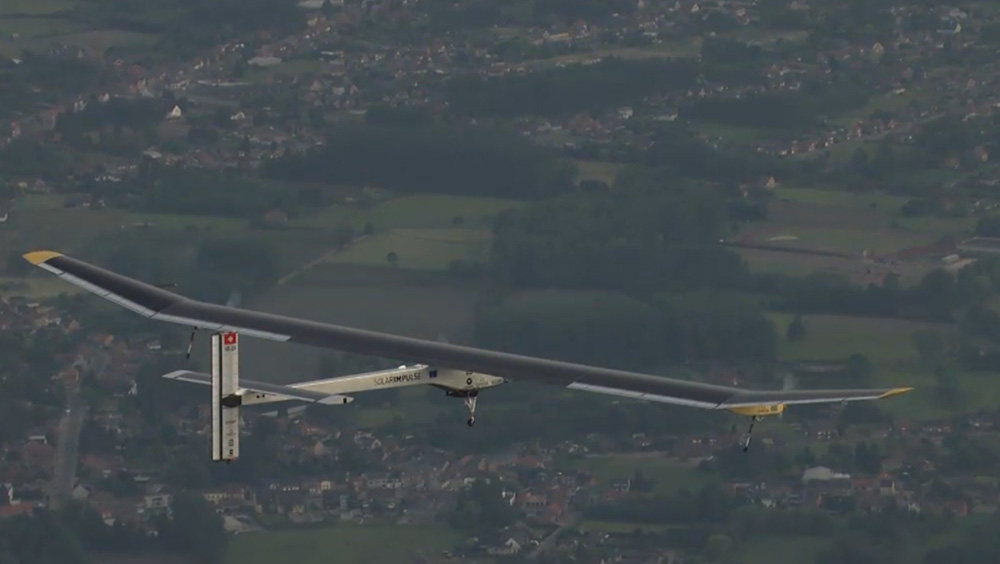
Swiss solar-powered aircraft Solar Impulse Saturday took off for its second international flight from Brussels for Paris but turned back for the Belgian capital after a series of glitches.

The pioneering aircraft took off at 1637 GMT in cloudy conditions, according to images shown on its website www.solarimpulse.com. Heavy rain and strong winds had prevented it from taking off at 0230 GMT as scheduled.

"The flight is far from being smooth and there have been a series of problems ever since the take-off from Brussels was delayed due to strong ground winds," a blog said.

"Shortly after take-off, when the pilot tried to retract the landing gear there was an unusual noise," and he decided to abort the move, it said, adding that this meant the plane would fly more slowly and use up more solar power.

The plane then turned back for Brussels, a spokeswoman for Solar Impulse told AFP.
Solar Impulse HB-SIA, which has the wingspan of a large airliner but weighs no more than a saloon car, made history in July 2010 as the first manned plane to fly around the clock and through the night on the sun's energy.

Last month it completed its first international flight from Switzerland to Belgium.
HB-SIA relies on 12,000 solar cells on its 64-metre (200-foot) wings to charge the batteries that provide the energy for the 10-horsepower electric motors driving four propellers.

It holds the endurance and altitude records for a manned solar-powered aeroplane after staying aloft for 26 hours, 10 minutes and 19 seconds above Switzerland, flying at 9,235 metres (30,298 feet).

This time, the high-tech plane is expected to rise around 2,500 metres in altitude. The flight is being transmitted live on www.solarimpulse.com. The Solar Impulse team is aiming to make possible transamerican, transatlantic and round-the-world flights -- in stages -- in 2013 and 2014 using a slightly larger aircraft.

The 49th international air show at Le Bourget, just outside Paris, runs from June 20 to 26.


eGenius electric plane takes flight with Airbus backing


A team at the University of Stuttgart has completed the maiden flight of a new electric flying machine they have named eGenius. The aircraft successfully completed a 20-minute flight followed by a two-and-a-half hour trip.

The eGenius is capable of hitting 235 km/h (146 MPH) for up to 400 kilometers (248.5 miles). It is powered by a 60-kilowatt motor, weighs 850 kilograms (1,874 pounds), and has some big backing from the likes of Airbus.

University of Stuttgart

EV Aircraft ELEKTRA ONE performs first 30 min flight [video]


The Elektra One EV aircraft performed the first flight on 19 Mar. 2011 at the Augsburg Airport in Germany. Jon Karkow, an well known test pilot and aircraft engineer performed the first flight. Flight characteristics and engne parameter were tested.

The ultra lightweight aircraft weighs just 220 pounds, plus an additional 220 pound battery pack. With a 660 pound weight capacity, there is ample room for a more than just the pilot.

The test pilot was very satisfied with the results. Three flights were performed. The climbing rate was 400 ft/min. A new 30 min. flight was performed on 23 Mar. Only about 3kW from the total on board of 6kWh energy was used.

Over the next two weeks a new variable pitch propeller and retractable landing gear will be installed for further testing.

Solar UAV QinetiQ Zephyr records ratified


The flight in July over the US army Yuma proving ground by the Qinetiq ‘Zephyr’ has been ratified by the Federation Aeronautique Internationale (FAI) as a world record for the longest unbroken time spent in the air by an Unmanned Aerial Vehicle (UAV). The flight lasted 10 times longer than the previous duration record held by the RQ 4A Global Hawk.


  • the absolute duration record for an Unmanned Air Vehicle – being filed at 336 hrs / 22 minutes
  • the duration record for a UAV (in the U/1.c / 50-500Kg category) – time as above
  • the absolute altitude record for a UAV (in the above category) – being filed at 70,740ft (21,561m)


Launched by hand, the aircraft flies by day on solar power delivered by amorphous silicon solar arrays that cover the aircraft’s wings and are no thicker than sheets of paper. These are supplied by Uni-Solar, the world’s largest producer of flexible solar panels. The solar arrays are also used to recharge the lithium-sulfur batteries that are used to power the aircraft by night and supplied by Sion Power Inc, a leading developer of the next high energy rechargeable battery technology. Together they provide an extremely high power to weight ratio on a continuous day/night cycle, thereby delivering persistent on station capabilities.

Around 50% larger than the previous version, Zephyr incorporates an entirely new wing design with a total wingspan of 22.5m to accommodate more batteries that are combined with a totally new integrated power management system. The entirely new aerodynamic shape also helps to reduce drag and improve performance. Zephyr’s ultra-lightweight carbon fibre design means it weighs in at just over 50Kg.

Previous records beaten include:


  • Surpassing the previous world record for the longest flight for an unmanned air system (set at 30 hours 24 minutes by Northrop Grumman’s RQ-4A Global Hawk on 22 March 2001).
  • Surpassing the Rutan Voyager milestone of 9 days (216hours) 3 minutes and 44 seconds airborne – previously the longest flight by an aeroplane without refuelling and set in Dec 1986. Quadrupling its own unofficial duration record of 82 hours, 37 minutes set in 2008

NASA Looking at Electric Railgun / Scramjet Launcher to replace Shuttle


Last week saw Navy researchers set a new world record with a test firing of a new 33 Megajoule railgun. Turns out NASA are also seriously considering a railgun to replace conventional rockets but in their case it would be 5x more powerful and two miles long.

An early proposal has emerged that calls for a wedge-shaped aircraft with scramjets to be launched horizontally on an electrified track. The aircraft would fly up to Mach 10, using the scramjets and wings to lift it to the upper reaches of the atmosphere where a small payload canister or capsule similar to a rocket's second stage would fire off the back of the aircraft and into orbit. The aircraft would come back and land on a runway by the launch site.

How To Fly Into Orbit:


Rev Up The Rail Gun
A 240,000-horsepower linear motor converts 180 megawatts into an electromagnetic force that propels a scramjet carrying a spacecraft down a two-mile-long track. The craft accelerates from 0 to 1,100 mph (Mach 1.5) in under 60 seconds- fast, but at less than 3 Gs, safe for manned flight.

Fire The Scramjet
The pilot fires a high-speed turbojet and launches from the track. Once the craft hits Mach 4, the air flowing through the jet intake is fast enough that it compresses, heats to 3,000ºF, and ignites hydrogen in the combustion chamber, producing tens of thousands of pounds of thrust.

Get Into Orbit

At an altitude of 200,000 feet, there isn't enough air for the scramjet, now traveling at Mach 10, to generate thrust. Here spaceflight begins. The two craft separate, and the scramjet pitches downward to get out of the way as the upper spacecraft fires tail rockets that shoot it into orbit.

Stick The Landing
The scramjet slows and uses its turbojets to fly back to Earth for a runway landing. Once the spacecraft delivers its payload into orbit, it reenters the atmosphere and glides back to the launch site. The two craft can be ready for another mission within 24 hours of landing.

"All of these are technology components that have already been developed or studied," NASA says. "We're just proposing to mature these technologies to a useful level, well past the level they've already been taken."

For example, electric tracks catapult rollercoaster riders daily at theme parks. But those tracks call for speeds of a relatively modest 60 mph -- enough to thrill riders, but not nearly fast enough to launch something into space. The launcher would need to reach at least 10 times that speed over the course of two miles in Starr's proposal.

The good news is that NASA and universities already have done significant research in the field, including small-scale tracks at NASA's Marshall Space Flight Center in Huntsville, Ala., and at Kennedy.

The Navy also has designed a similar catapult system for its aircraft carriers. The EMALS Electromagnetic Aircraft Launch System, which uses a linear electromagnetic accelerator motor, will replace the current C-13 steam catapults in the new USS Gerald R. Ford (CVN-78) currently under construction.

As far as the aircraft that would launch on the rail, there already are real-world tests for designers to draw on. The X-43A, or Hyper-X program, and X-51 have shown that scramjets will work and can achieve remarkable speeds.

Silent flight: Sikorsky's electric helicopter


A team at Sikorsky Innovation, the technology development arm of Sikorsky Aircraft, is attempting to develop the world’s first all-electric, near-silent helicopter in a programme known as ’Project Firefly’. The team’s plan is to validate the benefits of the electric rotorcraft in flight while addressing some of the challenges of making an environmentally friendly helicopter both commercially and technically viable.

’We’ve had electric cars, electric buses and electric street sweepers for a while now, but we really want to understand the unique difficulties associated with integrating electric propulsion into rotorcraft,’ said Jonathan Hartman, a programme manager for Project Firefly. ’In an ideal world, we would want an electric helicopter to compete on a one-to-one basis with your internal combustion aircraft today.’

Despite advances in electric powertrains for automotive applications, progress in aviation has been slow. The industry faces a very different set of challenges due to its high power requirements and Hartman believes that technology development has to begin now

’You can either wait until your technology is fully commercially ready and then just integrate it into your product, or you can get out there ahead of time and start learning about all these issues that will come up during construction. That’s what we’re doing.’

The Firefly team has retrofitted a 50-year-old military S-300C design with an electric motor and digital controller, together weighing in at 180lb. Much of the S-300C’s original design has remained the same to keep costs down, with the main difference being the addition of an interactive LCD monitor in the cockpit. Two battery packs, each made up of 150 individual 45amp-hour (Ah) lithium-ion cells, are the backbone of the energy-storage system. They sit outside the aircraft much like an agricultural spraying kit, and run at 370V to provide enough power for a continuous 15-minute flight.


’That’s obviously not a lot of time,’ said Hartman. ’There is one technology that needs to mature to make this a commercial reality and that is energy-storage distribution. There are projects out there that we are watching. If some of the technologies that are on the bench now can come out and provide the energy-surge capacity they are claiming, we could well see helicopter endurances in the half hour to the hour range instead of just 15 minutes, which is exciting.’

Sikorsky claims it has increased the propulsion efficiency of the helicopter by around 300 per cent from baseline. The use of an electric motor reduces the complexity of the helicopter, cutting down on the number of components and reducing maintenance costs. There is also a reduction in vibrations and associated acoustics with electric propulsion, which could one day lead to a new series of low-observable, optionally manned aircraft for both military and civil applications.

The benefits, however, sit against a long list of challenges. The motor must be air cooled rather than liquid cooled, and has to remain at operating temperature while sitting on the ground. Sikorsky presented this problem to US Hybrid, which came up with an adaptation of a motor it uses for surface-vehicle programmes, such as the electric-powered Humvee for the US Marine Corps. The group provided 40 per cent more power and added a number of control laws to allow the motor to run at a constant high rpm.

While a conventional motor requires time to engage and build up torque, an electric motor can do this straight away so further control laws were added to prevent pilots from taking off and landing too quickly. Feedback from pilots also showed that the lack of noise could affect handling. ’Our toughest challenge was on the human factor side,’ said Hartman.’We have this electric helicopter that produces substantially less noise than a traditional helicopter. All of the pilot cueing is basically gone and that presents some unique difficulties that a pilot never had to worry about before.’

To address this, integrated sensors were added that feed real-time aircraft health information to the pilot through an interactive LCD monitor. Monitoring of health data is done automatically through the flight-control computer and any potentially hazardous conditions are avoided with automatic system re-routing or electric shutdown. As well as providing information to the pilot, the system tracks critical stages of flight in real time allowing the team to rapidly prototype new ideas as it goes through the development programme.

The issue that poses the greatest challenge, however, is weight. ’The helicopter itself weighs empty several hundred pounds more than it did in its legacy configuration,’ said Hartman. ’What we did in the project was take the maximum weight of the aircraft, subtract out the motor, the weight of the cockpit, control and the pilot and fill the rest of it up with batteries. They are not the most weight-efficient batteries that are on the market today, but we went for reliability over weight and selected safe components that we knew would work… If a bus loses charge that’s one thing, but if a helicopter suddenly loses charge then you have a problem.’

Hartman is confident that with improvements in battery technology, weight will be reduced and reliability improved significantly allowing electric helicopters to compete with conventional aircraft. Hartman added that in the shorter term electric helicopters could have some interesting applications using endurances of between half-an-hour and an hour. ’My director has a fantastic vision. He would love to see a helicopter fly on a two-seat tour of the Grand Canyon. You and the pilot, no shaking, you don’t even have to wear headphones - you just enjoy the view. You can imagine something similar for applications in urban transportation.’

The Firefly project is undergoing component bench testing and is scheduled to move to ground testing and first flight early next year. It seems inevitable that at some point full-scale electric rotorcraft will be seen in our skies, but just when that will happen is anyone’s guess. ’I would need a crystal ball to tell you,’ said Hartman. ’But if the trajectory continues as it is, the next five to 10 years are going to be very interesting.’

The specs

Airframe: converted S-300C
System efficiency: 89 per cent during cruise, 91 per cent maximum power efficiency
Power: 190hp permanent magnet electric motor
Endurance: 15min
Lithium-ion battery: 150, 45Ah lithium-ion cells
Maximum velocity: 79knots
Boeing SolarEagle UAV can stay aloft for five years


Boeing's solar/electric-powered high altitude long endurance unmanned aerial vehicle, SolarEagle, has clinched a $89 million deal with the US Defense Advanced Research Projects Agency (DARPA) to develop and fly the unmanned aircraft capable of staying aloft for up to five years.

"SolarEagle is a uniquely configured, large unmanned aircraft designed to eventually remain on station at stratospheric altitudes for at least five years," explained Boeing spokesperson Pat O'Neil.

"that's a daunting task, but we have a highly reliable solar-electric design that will meet the challenge in order to perform persistent communications, intelligence, surveillance and reconnaissance missions from altitudes above 60,000 feet."

According to O'Neil, the SolarEagle demonstrator is slated to remain in the upper atmosphere for 30 days during testing - harvesting solar energy that will be stored in fuel cells and used to power the aircraft at night. 


The unmanned aircraft will also boast highly efficient electric motors and propellers, along with a high-aspect-ratio, 400-foot wing for increased solar power and aerodynamic performance.

O'Neil noted that the SolarEagle was only one of Boeing's rapid prototyping projects.
"efforts include the Phantom Ray, a fighter-sized, unmanned, advanced technology demonstrator scheduled to make its first flight in early 2011. 


"The hydrogen-powered Phantom Eye demonstrator, a High Altitude Long Endurance aircraft designed to stay aloft for up to four days, also scheduled to make its first flight in 2011."

The SolarEagle is expected to make its first demonstration flight in 2014.


.

Wireless Laser powered helicopter hovers for hours


LaserMotive has used a few watts of laser power to keep a 22-gram model helicopter hovering for hours at a time, thus adding to numerous other feats attained with the use of lasers. Though, there are many applications the technology like this could be used for, but LaserMotive’s prime concern is to power space elevators to lift objects into orbit. The traditional UAVs require a lot of power from batteries and fuel, and because solar-powered aircrafts too have limitations in staying afloat for a very long time, this ground-based laser propulsion technology could provide the power to enhance the time in air.

To demonstrate this laser power, LasesMotive at AUVSI Unmanned Systems Conference in Denver, Colorado, “focused light from an array of semiconductor diode near-infrared lasers down to a 7-centimetre beam, which automatically tracked a modified radio-controlled helicopter. The aircraft carried photovoltaic cells optimised for the laser wavelength, which converted about half the laser power reaching them to generate a few watts of electricity – enough to power the rotors of the little copter.”

New Scientist

.

Wireless microwave powered rocket lifts off


Scientists in Japan have successfully "launched" a tiny metal rocket using an unusual source of thrust - microwaves. The test was the latest a proof of principle for a kind of propulsion that has never been the beneficiary of the levels of investment poured into traditional chemical rockets, but which its proponents say could some day be a superior way to get spacecraft into orbit.

Sending rockets into space using a combustible mixture of on-board fuel isn't an optimal solution to the problem of escaping Earth's deep gravity well. Not only is it dangerous to strap humans and satellites on top of giant bombs, it's also incredibly wasteful: 90% of the weight of a rocket sitting on the launch pad is fuel. For example, the Space Shuttle burns 50% of it's lift off weight within the first minute of flight.

In the beginning of the 20th century, it occurred to Russian rocket scientist Konstantin Tsiolkovsky that there was another way: by keeping the energy source on the ground and beaming the required power to a rocket, it could be launched with very little fuel on board.

With the invention of the maser, or microwave laser, scientists were granted a tool to realize Tsiolkovsky's dream. So in the 1970's they began to model just what it would take. Some were optimistic about its potential to decrease the cost of going to orbit by orders of magnitude, but the bottom line is that, for a lack of funding, the technology never took off.

Every few years, however, someone reminds the world that it's at least possible to get a rocket off the ground with little or no fuel. The latest demonstration used a Gyrotron - essentially a maser - at the Naka Fusion Institute of the Japan Atomic Energy Agency. (This super high-powered microwave beam emitter was originally developed as part of Japan's contribution to ITER, the international effort to create a workable fusion reactor.)

Using this beam, the scientists were able to send pulses of microwave energy into the bottom of their hollow 126 gram rocket model, heating the air within to 10,000 degrees Celsius and resulting in its rapid expansion. The result is a little boom, "like thunder," they report.


.

Boeing's electric battery gas turbine hybrid propulsion system


If Boeing's latest vision gets off the ground, a hybrid propulsion concept similar to the engine-battery pairings increasingly seen in passenger cars could be aviation's answer to the fuel burn and emissions dilemma.

The research and technology people at Boeing reckon their concept for a 737-sized aircraft could be reality by 2035 if sufficient advances in battery technology can be achieved - but they admit that the battery question is a big if.

The conceptual aircraft, known as Sugar (Subsonic Ultra Green Aircraft Research) Volt, was one of five designs submitted by Boeing following an 18-month research challenge set by NASA. The goal was to design a 2030-era aircraft that burns 70% less fuel and emits 75% less nitrogen oxide than today's airliners.

Sugar Volt is a twin-engined aircraft fuelled by a combination of jet fuel and battery power. "We've added an electric motor to the shaft that drives the fan so that during take-off you run the gas turbine as usual, but you can also use the battery to get more power," says Marty Bradley, who heads Boeing's subsonic research team. He adds that the extra thrust provided by the battery could shorten take-off time.

When the aircraft reaches cruising altitude it can switch from burning jet fuel to using the battery-powered electric motor. Sugar Volt is designed to carry 154 passengers. It has a maximum range of 3,500nm (6,480km) and a 61m (200ft) wing span, although the wings are designed to fold so the aircraft can fit into the same airport gates served by today's narrowbodies.

Boeing says the aircraft would emit 65% less carbon dioxide than today's single-aisle aircraft, but an 80% reduction could be achieved if biofuels were used instead of kerosene. This reduction includes the US power grid emissions used to charge the batteries before flight. The hybrid electric propulsion system could also reduce NOx emissions by as much as 85%.

Bradley is keen to stress, however, that at present there is no battery powerful enough to make this vision a reality. Sugar Volt would require a battery that offers 750 watt hours/kg, but the best batteries in existence today only achieve 170-180 watt hours/kg.

"That's the bar we set for the battery technology folks. If they can reach that then we have an approach where we can compete with conventional aircraft. It's a stretch for them, but the technology is out there - we will just have to see if it evolves," says Bradley. An improved version of the most advanced lithium ion battery is one possibility, while lithium air battery technology improvements could also form the basis of what is required.

"If you take today's most advanced battery and improve it by 7-8% a year, by 2035 it might be ready," says Bradley, adding that Boeing is "calling for dialogue with the battery technology people".

Boeing Propose Electric Hybrid Commercial Airliner


Two Boeing-led teams completed 18-month studies and recently submitted their findings to NASA under a program called N+3, which denotes three generations beyond today's transport fleet.

After examining various subsonic and supersonic concepts, the teams came up with configurations that met the NASA-stated goals for dramatic improvements in operational and environmental performance over today's aircraft.

The Boeing subsonic team, which includes General Electric and Georgia Tech, looked at five concepts. The team's report provides detailed benefits and drawbacks as well as recommendations for further study, but doesn't show favorites. "No single concept met all of the study goals, so we did not pick a preferred concept," said Boeing's Marty Bradley, the team's leader.

However, the team found that one concept known as SUGAR Volt - which includes an electric battery gas turbine hybrid propulsion system - can reduce fuel burn by more than 70 percent and total energy use by 55 percent. This fuel burn reduction and the "greening" of the electrical power grid can greatly reduce emissions of life cycle carbon dioxide and nitrous oxide. Hybrid electric propulsion also has the potential to shorten takeoff distance and reduce noise.

The subsonic team's report concludes that hybrid electric engine technology "is a clear winner, because it can potentially improve performance relative to all of the NASA goals."

Boeing and the three other teams providing subsonic aircraft concepts have submitted proposals for a second phase of studies to begin developing the necessary new technologies. This contract award is expected in the next few months.

Meanwhile, the Boeing supersonic team, which includes Pratt & Whitney, Rolls Royce, General Electric, Georgia Tech, Wyle and M4 Engineering, focused on four concepts that include a low fuel burn/low boom swing-wing "arrow" configuration, a low sonic boom concept with a V-tail to shield noise and control the sonic boom, a joined wing alternate concept and an oblique "scissor" wing alternative concept.

Based on conceptual design studies, the team recommended to NASA a fixed wing configuration (nicknamed Icon II) with V-tails and upper surface engines, said Bob Welge, Boeing's leader of this team. The Icon II concept can carry 120 passengers in a two-class, single-aisle interior, and can cruise at Mach 1.6 to Mach 1.8 with a range of about 5,000 nautical miles.

The study acknowledges that supersonic aircraft inherently have less fuel efficiency than subsonic aircraft, but points out they offer offsetting productivity benefits because of speed. The study concludes that advanced technologies can reduce fuel burn enough that a supersonic aircraft could be economically and environmentally viable in multiple markets.

The study also indicates that these efficiencies can be achieved while meeting the same community noise certification limits as subsonic aircraft, with a reduction of the sonic boom noise to 65 to 75 decibels. "That may make it possible for a supersonic transport to operate at maximum cruise speed, even over land," Welge said.
The NASA N+3 supersonic program does not provide the option for a Phase II system study, but Welge said technology development research announcements are anticipated in the near term.


NASA

Solar powered UAV goes down in history as first "eternal plane"


The solar-powered craft completed two weeks of non-stop flight above a US Army range in Arizona before being commanded to make a landing.

The Qinetiq company which developed Zephyr said the UAV had nothing to prove by staying in the air any longer.

It had already smashed all endurance records for an unpiloted vehicle before it touched down on Friday.

"We are just really delighted with the performance," said project manager Jon Saltmarsh.

"It's the culmination of a lot of years of effort from a huge number of really talented scientists and engineers," he told BBC News.

Zephyr took off from the Yuma Proving Ground on Friday, 9 July.

After only 31 hours in the air, it had bettered the official world record for a long-duration flight by a drone; but then it kept on going, unencumbered by the need to take on the liquid fuel that sustains traditional aircraft.

Clear skies at 60,000ft delivered copious amounts of sunshine to its amorphous silicon solar arrays, charging its lithium-sulphur batteries and keeping its two propellers turning.

At night, Zephyr lost some altitude but the energy stored in the batteries was more than sufficient to maintain the plane in the air.

Zephyr is set to be credited with a new world endurance record (336 hours, 24 minutes) for an unmanned, un-refuelled aircraft - provided a representative of the world air sports federation, who was present at Yuma, is satisfied its rules have been followed properly.

Its fortnight in the sky easily beats the 30 hours, 24 minutes, set by Northrop Grumman's RQ-4A Global Hawk in 2001.

Zephyr has also exceeded the mark set for a manned, non-stop, un-refuelled flight, set in 1986 by Dick Rutan and Jeana Yeager, who stayed aloft for nine days (216 hours), three minutes. Their flight in the Voyager craft went around the world.

Profile raising

Jon Saltmarsh said the UAV, which has a 22.5m wingspan, was no longer an experimental plane and was now ready to begin its operational life.

The fact that Zephyr completed its demonstration during the Farnborough International Airshow - which takes place on the doorstep of the Qinetiq company - will have done wonders for the craft's profile.

Solar-powered high-altitude long-endurance (Hale) UAVs are expected to have a wide range of applications.

The military will want to use them as reconnaissance and communications platforms. Civilian and scientific programmes will equip them with small payloads for Earth observation duties.

Their unique selling point is their persistence over a location. Low-Earth orbiting satellites come and go in a swift pass overhead, and the bigger drones now operated by the military still need to return to base at regular intervals for refuelling.

"Qinetiq is now looking to the Ministry of Defence and the DoD (US Department of Defense) to put a system into service," said Mr Saltmarsh.

"We have proved the concept; we have proved we can provide persistence; we have proved we can put useful payloads on to it that will actually do things the MoD has a requirement to do."

The Zephyr flight is the second event of note this year in solar-powered aviation. Earlier this month, Andre Borschberg became the first person to pilot a manned solar plane through the night.

Unmanned solar plane smashes records


A unmanned solar aircraft has smashed the world record for continuous flight.
The "Zephyr" plane, developed by UK defense technology company, QinetiQ, took off from the U.S. Army's Yuma Proving Ground in Arizona on Friday July 9. Seven days on, it is still flying high.

Zephyr program director, Jon Saltmarsh said "It's extremely exciting. What we now have is an eternal plane. It has the same amount of fuel at the start of one day as it does at the start of another."

The aircraft has already doubled its own unofficial record of over 82 hours and smashed the previous world record for unmanned flight of 30 hours and 24 minutes, set in 2001 by U.S. aerospace company, Northrop Grumman's RQ-4A Global I.

The Zephyr project was conceived in 2001 and secured funding from the UK's Ministry of Defense (MOD) three years later. After several prototypes, Saltmarsh believes QinetiQ has now created an aircraft that demonstrates genuine military utility.

"It has the persistence to stay up there for long periods of time and it carries payloads that are doing things that the military will find useful." Saltmarsh says its key role will be in aiding communications.

"Sitting at 60,000 feet it's ideal for getting a line of sight between two people in different valleys," Saltmarsh said. "But it could also carry surveillance payloads." QinetiQ also says it will save the military money, performing many of the tasks currently carried out by manned aircraft.

Weighing in at just 53 kilograms the plane has a wingspan of 22.5 meters and a wing area of around 30 square meters, the top side of which are covered in solar panels thinner than a sheet of paper.

The panels are rigged up to lithium-sulphur batteries which power the plane at night.
QinetiQ began building the latest Zephyr model 18 months ago and hope to start full scale military trials a year from now.

The company says that Zephyr will also find a civilian use helping communications in disaster relief situations, as well as forest fire monitoring.

"You can sit above a fire, with heat sensor technology and identify hotspots very quickly," Saltmarsh said.

Zephyr shows no sign of running out of power anytime soon, and Saltmarsh is hopeful it will stay in the air for another seven days, when the plane will finally return to Earth.

Solar Plane Lasts All Night Long


Swiss researchers yesterday marked a major milestone in the development of a solar-powered, single-pilot aircraft that they hope will eventually circumnavigate the globe. They kept their craft aloft through an entire night on stored solar energy.

In the wake of the event, the pilot, André Borschberg--CEO and cofounder of the Solar Impulse project--declared: "I have just flown more than 26 hours without using a drop of fuel and without causing any pollution!" The plane took off from a Swiss airbase early Wednesday and landed there at dawn Thursday.

Of course, it is a long way from this stunt to an aviation industry that isn't reliant on energy-dense jet fuel to hoist hundreds of thousands of pounds of cargo and passengers to cruising altitude. Unlike cars--which can today drive respectable distances on stored electrical energy--commercial aircraft will be dependent on liquid fuels for a long time.

But the Solar Impulse plane does include some novel engineering feats. Its wings are covered with 11,000 solar cells, and it uses lightweight composite structural parts and has a wingspan of 210 feet, not far from that of the world's biggest commercial jet, the Airbus A380, which has a wingspan of 260 feet. Keeping the plane's weight down to 3,500 pounds required optimizing electrical components in order to keep battery size as small as possible. The design was honed with computer modeling help from the European Space Agency and the Swiss Federal Institute of Technology. Still, the plane must fly at a pokey 28 miles per hour to save electricity. The lessons learned from the test flight will be used to develop an improved version of the plane that would attempt to fly around the world.

"It's good engineering, as you would expect from a Swiss team," said John Hansman, professor of aeronautics at MIT. But while the project is interesting, he says: "Solar will be a niche application for aircraft. It's hard to have enough energy capture to use for transportation, and solar cell efficiency is not high enough."

Despite their dubious commercial potential, lightweight solar-powered planes could be crucial to conducting long-term surveillance, and that's why various governments, including that of the United States, have been researching the technology. NASA's solar-powered Helios aircraft, one such unmanned effort, disintegrated due to turbulence during a 2003 test flight.

The unmanned solar powered record, set by QinetiQ's Zephyr UAV in 2008, stands at 82 hours 37 minutes or 3 1/2 days, exceeding the current official world record for unmanned flight which stands at 30 hours 24 minutes set by Global Hawk in 2001.

In 1999, the leader of the Solar Impulse project, Swiss adventurer Bertrand Piccard, became the first person (along with his copilot) to fly nonstop around the world in a balloon. "This is a highly symbolic moment," he said in a statement yesterday. "Flying by night using solely solar power is a stunning manifestation of the potential that clean technologies offer today to reduce the dependency of our society on fossil fuels."

Solar-powered Swiss plane gets its day in the sun (w/Video)


An experimental solar-powered plane whose Swiss makers hope someday to fly around the globe soared into uncharted territory Wednesday — the cold, dark night.

The team of adventurers and engineers behind the Solar Impulse project are already celebrating an aviation milestone for the longest solar flight after keeping the single-seat prototype aloft for almost 15 hours.

But with the goal of 24 hours of nonstop flight, the team set its sights on keeping the sleek aircraft with a 207-foot (63-meter) wingspan in the air until Thursday morning.

Pilot Andre Borschberg "will stay up there as long as possible," said Bertrand Piccard, the project's co-founder.

"Hopefully he will still be in the air at sunrise tomorrow. That is the challenge."
Borschberg took off from Payerne airfield into the clear blue sky shortly before 7 a.m. Wednesday, allowing the plane to soak up plenty of sunshine and fly in gentle loops over the Jura mountains west of the Swiss Alps.

As the sun set, technicians hoped the Solar Impulse's batteries — charged from the 12,000 solar cells fixed to the wings and body — would keep the four-engine plane engines airborne through the night. The batteries would begin charging again at dawn.
Earlier in the afternoon, Piccard told The Associated Press the flight was going "extremely well."

A record-breaking balloonist whose father and grandfather also accomplished pioneering airborne and submarine feats, Piccard has become the figurehead for the project and will be one of two pilots when it eventually takes off for its round-the-world attempt in 2013, with a scheduled five stops along the way.

Piccard said the night flight was a key step toward achieving that ultimate feat.
"The goal of the project is to have a solar-powered plane flying day and night without fuel," he said. "This flight is crucial for the credibility of the project."
At 9:30 p.m., Piccard told reporters that strong winds had pushed the plane off course, cutting the safety margin by one hour.

"If there is one hour missing tomorrow morning, it will be that hour," he said.
Should Borschberg or the team decide that it looks like the Solar Impulse won't make it through the night, the pilot will have the difficult task of landing the fragile aircraft before the batteries run out.

Borschberg was circling in Swiss airspace, first at 28,000 feet (8,535 meters) and then gently easing down through the night — always within gliding range of Payerne airport, so he can land if the plane runs out of energy, Piccard said. Still, the 57-year-old former Swiss fighter pilot is wearing a parachute — just in case.

Engineers in Payerne are closely monitoring every aspect of the aircraft, which has a thin fuselage and a wingspan of a Boeing 777 passenger jet. Its top speed is only 75 mph (120 kph) and it has no room for passengers or baggage, so it is as light and efficient as possible.

Piccard said the test flight — the third major step after its first "flea hop" and an extended flight earlier this year — will demonstrate whether the round-the-world trip is feasible.

The team had hoped to make its 24-hour test flight last week, when days in the northern hemisphere were even longer. But a problem with a key piece of communications equipment forced them to ground the plane while modifications were made.

Piccard, who achieved the first nonstop circumnavigation of the globe in a balloon, the Breitling Orbiter III, in 1999, said the next major step will be a solar Atlantic crossing. That will be done in a second, lighter prototype, because it will involve new challenges and dangers, he said.

Although the goal is to show that emissions-free air travel is possible, the team said it doesn't see solar technology replacing conventional jet propulsion any time soon. Instead, the project is designed to test and promote new energy-efficient technologies.

"Solar Impulse is a message as much as an airplane," he said.

Supersonic Green Machine


This future aircraft design concept for supersonic flight over land comes from a team led by the Lockheed Martin Corporation.

The only commercial supersonic aircraft to go into service, the Concorde, could only fly between New York and either Paris or London because most countries banning Concorde flights over land due to the sonic boom that constantly trails the aircraft at speeds above MACH 1.

The Lockheed team's simulation shows possibility for achieving overland flight by dramatically lowering the level of sonic booms through the use of an "inverted-V" engine-under wing configuration. Other revolutionary technologies help achieve range, payload and environmental goals.

One other major problem with the Concorde was that due to the enormous fuel consumption of the aircraft at MACH 2, the cost of a typical return transatlantic flight was around $24,000 - or the price of a new small car. To solve this problem we're wondering if either Boeing, Lockheed Martin or NASA are looking to resurect Project Pluto, a nuclear powered ramjet experiment from the 1960s or some of the aircraft reactor experiments (ARE) from the 1950s based on Molten-Salt Thorium Reactors.

This Lockheed Martin concept is one of two designs presented in April 2010 to the NASA Aeronautics Research Mission Directorate for its NASA Research Announcement-funded studies into advanced supersonic cruise aircraft that could enter service in the 2030-2035 timeframe.

EADS unveils four-engine electric aerobatic plane


EADS Innovation Works is casting its net wide in the search for solutions to aviation's environmental challenges. At the Green Aviation Show under way (June 18-22) in Le Bourget, Paris, EADS's research arm is presenting the first four-engined, all-electric aerobatic aircraft, based on the tiny Cri-Cri homebuilt.

Partnered by Aero Composites Saintonge and the Greencri-cri Association, EADS Innovation Works has presented Cri-Cri, the first-ever four-engined all-electric aerobatic plane, at the Green Aviation Show in Le Bourget from 18 to 22 June.

This aerobatic plane incorporates numerous innovative technologies such as lightweight composite structures that reduce the weight of the airframe and compensate for the additional weight of the batteries, four brushless electric motors with counter-rotating propellers which deliver propulsion without CO2 emissions and significantly lower noise compared to thermal propulsion, and high energy-density Lithium batteries.

The combined utilisation of these environment-friendly technical innovations enables the Cri-Cri to deliver novel performance values: 30 minutes of autonomous cruise flight at 110 km/h, 15 minutes of autonomous aerobatics at speeds reaching up to 250 km/h, and a climb rate of approximately 5.3 m/sec.

Set to undergo its first flight tests in the next few days, this four-engine electric plane paves the way for a new generation of environment-friendly high-performance aircraft.

Northrop Grumman wins contract to build US Army's long-endurance hybrid airship


A new hybrid airship weapons system, just larger than the length of a football field, will take to the skies in just 18 months to provide an unblinking, persistent eye for more than three weeks at a time to aid U.S. Army troops in Afghanistan, according to Northrop Grumman Corporation.

The company today announced it has been awarded a $517 million agreement to develop up to three Long Endurance Multi-Intelligence Vehicle (LEMV) systems for the U.S. Army. Northrop Grumman has designed a system with plug-and-play capability to readily integrate into the Army's existing common ground station command centers and ground troops in forward operating bases--the main objective to provide U.S. warfighters with persistent ISR capability to increase awareness of the ever changing battlefield.

"This opportunity leverages our longstanding leadership positions in developing innovative unmanned air vehicles, C4ISR weapon systems, and leading edge systems integration, and moves Northrop Grumman into this rapidly emerging market space of airships for the military and homeland defense arenas," said Gary Ervin, corporate vice president and president of Northrop Grumman Aerospace Systems sector.

Under the agreement, awarded by the U.S. Army Space and Missile Defense Command/Army Forces Strategic Command, Northrop Grumman will design, develop and test a long-duration hybrid airship system within an 18-month time period, and then transport the asset to the Middle East for military assessment.

"It is critical that our warfighters are equipped with more enabling integrated ISR capability to tackle today's and tomorrow's conflicts," said Alan Metzger, Northrop Grumman LEMV program manager. "Our offering supports the Army's Joint Military Utility Assessment that this disruptive innovation must meet the Army's objective of a persistent unblinking stare while providing increased operational utility to battlefield commanders. Part of our innovative offering includes open architecture design in the payload bay to allow sensor changes by service personnel in the field."

LEMV will sustain altitudes of 20,000 feet for a three-week period, and it will operate within national and international airspace. It will be forward-located to support extended geostationary operations from austere operating locations using beyond-line-of-sight command and control.

Northrop Grumman has teamed with Hybrid Air Vehicles, Ltd. of the United Kingdom using its HAV304 platform, Warwick Mills, ILC Dover, AAI Corporation, SAIC, and a team of technology leaders from 18 U.S. states to build LEMV. Northrop Grumman will provide system integration expertise and flight and ground control operations to safely take off and land the unmanned vehicle for worldwide operations.