Blog Archive
-
▼
2011
(1169)
-
▼
August
(19)
- University of Michigan and Ford researchers see pl...
- Nissan delivers first Leaf in France
- Ford Focus Electric Will Hit 19 Markets in Spring ...
- Nissan LEAF battery technology Explained [video]
- Toyota shooting for Nurburgring EV Lap record on A...
- Porsche 911 GT3 R Hybrid to make Monterey Le Mans ...
- Toyota and Tesla to Build RAV4 EV in Ontario Canada
- Opel/Vauxhall to receive 10,000 Amperas from GM ne...
- Transit Connect Electric Vans enter Oxford to Lond...
- No electric motors in F1 pits, Ecclestone says
- Porsche Hybrids Then And Now [video]
- Mini E UK trials reveal ease of EV use
- Fisker Karma Test Drive around Santa Monica [video]
- Nissan says electric car can power family home [vi...
- How It Works: The All-Electric Ford Focus [video]
- Electric Raceabout In-Car Lap of the Nürburgring [...
- Nissan claims electric car was not given fair chan...
- Tesla Model S Alpha track testing [video]
- Fully Charged | Top Gear | Eco Rally | episode 27 ...
-
▼
August
(19)
Toyota Extends Production Halt until March 22
“A decision on when vehicle production will resume in Japan has yet to be made,” the company said in a written statement.
However, the world’s largest automaker noted that it will resume production of replacement parts for vehicles already on market beginning on Thursday, March 17, adding that it also plans to restart manufacturing parts for overseas production on Monday, March 21.
Earthquake and Tsunami in Japan
The full extent of damages caused by the earthquake and the ferocious tsunami remain unknown for now, but we’re already hearing news of people being evacuated and many homes and factories destroyed.
On the automotive front, Toyota and Honda were forced to shut down some of their production plants and evacuate their workers from several factories in the quake zone. According to reports, Toyota, which has a large manufacturing presence in northern Japan, was affected the most with the shutdown possibly affecting production of cars like the Yaris sedan and the Scion xB and xD models.
Honda initially closed down both its Suzuka and Sayama plants, but production at the first factory resumed shortly after. The Sayama plant, which manufactures the US-bound Fit among other models, remains closed.
Videos
Photos
Electric car
2010 Volvo S60 Elegant Car Concept
A few days before Christmas, Volvo Cars treating the automotive world to unwrap the beginning of a car that will shine brightly on the streets for years to come.
The Volvo S60 Concept gives the car world a glimpse of what the all-new Volvo S60 is going to look like when it arrives in 2010.
The all-new S60 will be one of the strongest players in a segment where the competition is razor-sharp,’ says Volvo Cars President and CEO Stephen Odell.
The coupe-inspired lines that gave the original S60 its characteristic stance are even more pronounced in the next generation.
‘The sporty design gives visual promise of an enthusiastic drive and I can assure you here and now that the all-new S60 will live up to that promise. The driving properties are better than in any previous Volvo. The car’s technology will also help you to be a better and safer driver,’ says Stephen Odell.The concept car reveals that the Volvo Cars design team is stepping up to the next level in the development of the products’ DNA.
‘The concept car’s exterior gives a clear indication of what customers can expect of the all-new S60. On the inside we’ve been even more daring – there the focus has been on creating a vision of the future in the slightly longer perspective,’ says Volvo Cars Design Director Steve Mattin.Focus EV to use Liquid Cooled Battery

Ford announced September 2 its Focus Electric, due out next year in the U.S., will contain a lithium ion battery pack with a liquid-based thermal management system.
Ford will use for the Focus a lithium-ion battery pack which will use heated and cooled liquid to handle one of the most dreaded things in an EV: overheating batteries. The liquid will be used by the car to keep the heat level to a minimum, hence increasing both the range and life span of the pack.
Ford is still developing the car, but the prototype we drove had a 23 kilowatt-hour lithium ion pack, which makes it about the size of the air-cooled pack in the Nissan Leaf. By using active thermal management, Ford says it will maximize battery life and range and optimize charging by heating, or cooling, the pack to the best temperature before pulling juice from the grid.
The introduction of this type of electronic cooling, will extend the batteries lifespan and also help to gain the maximum performance. By keeping the cells cool the active thermal management will be able to prevent the likelihood of cracks in the electrodes. These cracks can start to effect the batteries power and reduce the charge capabilities. On initial plug-in the management system will run a precondition of the batteries before it allows charging to begin.
The Focus Electric, which will be released in the U.S. late this year and in 2012 in Europe, is one of five electrified vehicles Ford will release over the next three years. The Ford Transit Connect Electric small commercial van arrives in late 2010, followed by two next-generation hybrid electric vehicles, as well as a plug-in hybrid electric vehicle in North America in 2012 and Europe in 2013.
Source: Ford
Press Release
FORD USES INNOVATIVE LIQUID-COOLED BATTERY SYSTEM TO HELP FOCUS ELECTRIC OWNERS MAXIMIZE RANGE
- The all-new Ford Focus Electric, which debuts in late 2011 in the U.S. and 2012 in Europe, will be powered by a lithium-ion battery system that utilizes cooled and heated liquid to regulate battery temperature, extend battery life and maximize driving range
- The innovative thermal management technology helps the Focus Electric operate efficiently in a range of ambient temperatures
- Focus Electric is one of five new electrified vehicles Ford will deliver over the next three years in North America and Europe. The Focus Electric will be built at Ford's retooled Michigan Assembly Plant
Thermal management of lithium-ion battery systems is critical to the success of all-electric vehicles because extreme temperatures can affect performance, reliability, safety and durability. Ford has chosen an advanced active liquid-cooling and heating system to regulate the temperature of its lithium-ion battery packs, which are designed to operate under a range of ambient conditions.
"All-electric vehicles do not have a conventional engine on board, so it is critical we maximize the performance of the battery under various operating temperatures," said Sherif Marakby, Ford director, Electrification Program and Engineering. "Active liquid systems are more effective than air systems at regulating lithium-ion battery temperature. As a result, the active liquid system on Focus Electric will play a key role in providing our customers with the best performance possible."
The active liquid cooling and heating system also enables the Focus Electric to automatically precondition the battery pack temperature during daily recharging. When the vehicle is plugged in to the power grid, the vehicle system will be able to warm up the battery on cold days and cool it down on hot days.
The Focus Electric will be built at Ford's retooled Michigan Assembly Plant and will be available in late 2011. The vehicle will have an expected range of up to 100 miles and use no gasoline at all.
Battery thermal management in action
While air-cooling methods work well for many of today's smaller car battery systems, the larger, more complex lithium-ion battery technology powering Ford's all-electric vehicles calls for an aggressive thermal management system.
An active liquid system heats or chills a coolant before pumping it through the battery cooling system. This loop regulates temperature throughout the system against external conditions.
On hot days, chilled water absorbs heat from the batteries, dispersing it through a radiator before pumping it through the chiller again. On cold days, heated water warms the batteries, gradually bringing the system's temperature to a level that allows it to efficiently accept charge energy and provide enough discharge power for expected vehicle performance.
"Extreme temperatures impact a battery's life and performance, making it crucial to have an effective cooling and heating system to regulate temperature for these demanding applications," said Anand Sankaran, Ford executive technical leader, Energy Storage and HV Systems.
The liquid cooling system also plays a role in charging the vehicle. When the all-electric Focus is plugged in to recharge, the vehicle control system will automatically precondition the battery, if needed, to the optimal temperature before accepting charge. If the battery is already at the optimal temperature, the system will automatically accept charge and maintain an optimal temperature.
"We are working closely with our technology partners to accelerate the development of our lithium-ion battery systems to help our future EV customers get the most out of their vehicles," Marakby said. "Our goal is to build an electric vehicle that delivers on the quality and performance customers have come to expect from Ford."
Focus Electric is one of five electrified vehicles Ford will release over the next three years. In addition to the Focus Electric, the Ford Transit Connect Electric small commercial van arrives in late 2010, followed by two next-generation hybrid electric vehicles, as well as a plug-in hybrid electric vehicle in North America in 2012 and Europe in 2013.
Electrified vehicles are one part of Ford's broader strategy to offer a wide range of environmentally friendly, advanced technology solutions to improve fuel economy and lower CO2 emissions affordably for customers around the world.
Audi Sound Concept features 62 speakers

Audi Sound Concept is the most advanced project of the entertainment development engineers in Ingolstadt. The project is internally dubbed the Audi Sound Concept and is being tested on a Q7 model. This design boasts an insane 62 speakers in the vehicle, consisting of five woofers, five tweeters and fifty-two mid-range speakers in the instrument panel beneath the windshield, in the roof pillars, and in the doors.
The system consists of five tweeters spread between the dashboard and the rear seating area, a woofer in each of the four doors, a single subwoofer out back, and a whopping 52 midrange speakers wrapping the perimeter of the cabin and enveloping the passengers in 360 degrees of sound. You're definitely not going to want to crank this rig up to 11.
Moreover, five units are integrated into each door sill, thanks to modifications that included cutouts in the sheet metal, new bezels and lower interior door release handles.
Development of the system took place in both the €100,000 listening facility and the €10 million audio lab at Audi HQ in Ingolstadt.
Press Release
New approaches to perfect sound - Hi-fi expertise at Audi
High-end quality for listening pleasure is a field of technology that is becoming increasingly important. Audi is taking the lead in the advancement of this technology. Audi's successful collaboration with premium suppliers Bang & Olufsen and Bose is already setting standards, and the Audi development engineers have also established broad-based proprietary know-how independent of these partnerships. Their latest project takes an entirely new technical approach - and could turn out to be the next revolution in the hi-fi sector.
62 speakers: the Audi Sound Concept project
Peter Gleim's eyes light up when he cranks up the volume. The engineer works in Infotainment Development at Audi in Ingolstadt, where he heads the Audi Sound Concept project. His test subject is a Q7: Standard on the outside, interior modifications have transformed it into a rolling hi-fi studio that takes a radically new approach.
The idea behind Audi Sound Concept is a physical principle called wave field synthesis, which states that the front of any individual wave can also be considered as superposition of individual waves. In the world of acoustics this means that a sound wave can be recreated by a multiplicity of small sound sources placed closely adjacent to one another along the wave front.
The principle was first put into practice by Dutch scientists in the late 1980s, and it can be experienced today in a movie theater in Ilmenau, in the German state of Thuringia. Each of the 192 individual speakers at the Linden Lichtspiele movie theater is driven separately by a fast computer - at the precise moment in which the virtual wave front would pass through its point in space. Some signals are delayed by milliseconds, depending on the location of the speaker. The result is fascinating: Each moviegoer experiences perfect audio spatialization in optimal sound.
One of the driving forces in the field of wave field synthesis is the Fraunhofer Institute for Digital Media Technology (IDMT) in Ilmenau. Audi began its development work in collaboration with the IDMT five years ago. The current status of the project is the Q7 prototype, which is parked in a workshop. A powerful amplifier takes up most of the space in the luggage compartment, and thick cables connect it to three PCs.
Installed in the Audi Q7 are 62 speakers - five woofers and five tweeters plus 52 mid-range speakers in the instrument panel beneath the windshield, in the roof pillars and in the doors. Five units are integrated into each door sill - with Audi-typical perfect workmanship. Specialists made cutouts in the sheet metal, fabricated new bezels and lowered the interior door release handles.
"Prepare to be amazed," says Gleim, as his eyes light up and he cranks up the volume. A sound like a thunderhead issues from the speakers - an artful mix of music, traffic noise and animal sounds. A female narrator guides the listener through the acoustic hubbub, dancing past the listener on the right and at other times on the left. The whole time the listener's ears are surrounded by the sounds of driving cars and roaring lions. A marching band seems to march from side to side through the Q7 before finally a helicopter flies a lap around the cabin below the headliner.
"That is specially created wave field material," says Gleim, "comprising up to 32 tracks, with specific spatial information for each of those tracks." There are no corresponding audio media available on the market because there are no playback devices, either. A few film studios are already producing films with the method, however."
New stereo sound: the wide virtual stage
Wave field synthesis is not dependent on special material to demonstrate its strengths, however. It also coaxes entirely new acoustic images out of conventional stereo signals. As Gleim explains, "We can simulate any wave front. With stereo, we can generate a sound as if the two speakers were located far outside the car. And we can also add any desired spatial impression computationally - not as a sound effect, but as a mathematically precise simulation."
The sample for this is also very convincing. The vocals come from far off to the left, seemingly from the corner of the workshop, with the guitar coming from the other corner. This impression remains the same regardless of whether the listener is behind the wheel or on the back right seat of the Audi Q7. And sound quality is always first class - with sparkling trebles, crystal-clear midrange and dry bass. Even the slight buzz as the guitarist's fingers hit the strings makes its way to the ear with extreme precision.
"Our goal was to show what is technically feasible; to explore the limits," explains Denis Credé, Head of Sound Development at Audi. "What we are learning will be integrated into the sound systems of tomorrow. It's like with racing: A lot of what is first tried out on the race tracks of this world later shows up in modified in production vehicles. The Audi Sound Concept project is like racing for sound systems."
Wide-ranging know-how: Entertainment Development at Audi
Audi Sound Concept is the most advanced project of the entertainment development engineers in Ingolstadt. Audi has accumulated broad-based know-how in hi-fi technology in just a short time. The brand began collaborating with the upscale American supplier Bose a good twenty years ago; the collaboration with Bang & Olufsen began around the turn of the millennium.
Audi began offering the advanced sound system from the Danish sound wizards in the A8 luxury sedan in fall 2005. The 14 active speakers, including two acoustic lenses with anodized aluminum grilles, and 1,100 watts of amplifier power brought high-end sound to the automobile direct from the factory for the first time. The openly proclaimed collaboration between the two companies was another first in the European automobile industry. It proved to be a tremendous success for both sides - the advanced sound system has a penetration rate of greater than 10 percent in both models, the A8 and Q7, in which it is available.
If a new Audi model is to be equipped with a new premium or advanced sound system, the development work is performed primarily at Bose or Bang & Olufsen. The Audi engineers prepare precise requirement specifications in which the system layout - the type, number and installation location of the speakers - plus the speaker characteristics, the design of the amplifier and a target sound appropriate for the vehicle are defined.
Prototype vehicles are sent to Esslingen, Germany, and Struer, Denmark, where the partners work on the speakers, enclosures, amplifiers and acoustic algorithms. The last step is fine-tuning the sound, which is performed together with the Audi specialists in Ingolstadt. The "Sound Commission," a body comprising representatives from all units of the company, is responsible for final acceptance and approval.
How close does the high-end sound in a new Audi A8 come to the reality of the recording? "The determining factors are always the installation locations in the car and the quality of the components," explains Gleim. "When you order a car with the advanced sound system, you get the best speakers available anywhere. Many of them have membranes made of a fiberglass composite, which has a very natural and linear sound."
Pure sound is technically feasible - but not desired. "A linear frequency response in the car would be boring," says Gleim. The tight interior does not allow the sound to spread out like in a living room. Cushions and upholstery absorb it, which is why the low frequencies must be overdriven to a certain extent. The electronic fine-tuning - the tweaking of the algorithms in the sound processor - handles this.
"We deliver a certain fun factor with our compact and sporty models," explains the sound development engineer. "In the A8 and Q7, however, the sound is more subtle and natural. There is no ultimate ideal, though, because each person perceives sound in their own unique way."
Proprietary development: the Audi sound systems
Below the high-end and premium systems, Audi offers additional systems such as the Audi sound system, which also uses impressive technology to produce excellent sound quality. Because Audi alone is responsible for the design and tuning of these systems, the development engineers have developed an extensive foundation of expertise.
The Electronics Center established at the Ingolstadt plant in 2003 includes a sound laboratory, where the sound systems undergo rigorous testing during the development phase. The engineers test the speakers and amplifiers offered by the suppliers, beginning with the very first sample level and assess the quality delivered, in part by means of exhaustive listening comparisons.
The laboratory features equipment valued at nearly €10 million - from the microphones and the special amplifier test bed custom-developed to Audi specifications to the laser vibrometer. The latter uses a laser to scan the surface vibrations that occur on the speaker membrane, the speaker housing or the door in which the speaker is installed.
The color graphics produced precisely indicate if the membrane does not oscillate properly across its entire surface. "Weaknesses in a speaker are very often a simple question of design," says Gleim's colleague, Wolfram Jähn. "In many cases, the manufacturer can resolve these with minor changes, such as details of the curvature or the overlap between the paper and the rubber at the bead."
Speakers are analyzed at the Audi sound laboratory in a testing room, which is a room-in-room construction. The testing room is mounted on thick elastomer bearings and is completely decoupled from the rest of the building. An absolute necessity given its direct proximity to a roller dynamometer.
All six sides of the testing room feature large fiberglass wedges covered in silk that break up the sound. A floating wire lattice serves as the floor.
The testing room is acoustically dead - the human voice loses its richness here. The room is also often used to refine operating noises in the cabin, i.e., to fine tune clicking rotary knobs and switches. "As far as we know, none of our competitors have such a facility," says Jähn.
The listening room: resetting your ears
Whereas the testing room is used for mathematical analysis, the adjacent listening room is tailored for the subjective experience. It, too, is an acoustically optimized room-in-room construction - the special wooden double walls backed with insulation only allow the linear reflections desired. The precisely calibrated, high-end sound system installed here costs around €100,000 and its tube-based end stages are the size of small refrigerators.
"The listening room is our acoustic magnifying glass," explains Jähn, "where we check what really is on a CD or DVD. This is important because your ears quickly get used to a sound and sometimes interpret errors as interesting effects. We test our sample speakers blind. We can compare them to the optimum and reset our ears."
Thanks to these detailed tests and comparisons, the sound development engineers at Audi can define detailed specifications for the speaker suppliers.
Another element for success is the tight networking between Technical Development, Production and Quality Assurance at Audi. This enables requirements from daily production work and the real-world customer experience to flow into the development of new sound systems.
The quality of the sound systems has gotten significantly better in recent years as a result, according to Gleim. And the engineers are constantly learning - at a rapid pace, day-in, day-out. Audi will further strengthen its leadership position in the high-end sector.
Ferrari Wireless GT Cockpit 430 is the Ultimate Experience for Racing Games [Video]

Thrustmaster has just released its newest gaming accessory, The Ferrari Wireless GT Cockpit 430 Scuderia Edition will make you feel like you really are racing in a luxury racing car. The Ferrari Wireless GT Cockpit 430 Scuderia Edition features resembles is a cockpit ensemble that includes a built-in wheel and pedal set that will work on PS3 and a PC.
The wireless system is compatible with the PlayStation 3 and PC (Xbox fans are left stranded by the side of the road), but if you thought the actual Scuderia was expensive, the 23-pound Thrustmaster setup will set you back $250.
For starters, the whole setup is wireless. Plug the 2.4 GHz receiver into the USB port of a PC or PS3, and you'll be driving in no time. No pesky cables to trip over or wear out. We're also assuming it sends the standard peripheral signals Windows and PS3 games understand, which would make it compatible with any well-developed racing game. Aside from brake and accelerator pedals, the paddle shifters and buttons built into the steering wheel provide a pretty comprehensive control suite.
Press Release:
Thrustmaster Unleashes Real Racing Power with Ferrari Wireless GT Cockpit 430 Scuderia Edition
Thrustmaster has created the ultimate cockpit that puts you in the driver's seat of your favorite racing games
New York, NY - (May 26, 2010) - Thrustmaster, the innovative PC and console accessory brand, unveils its newest gaming accessory release: a pre-equipped, streamlined, Ferrari-licensed cockpit, that's foldable and ready to be set up anywhere. The Ferrari Wireless GT Cockpit 430 Scuderia Edition is a cockpit ensemble featuring a built-in wheel and pedal set, for PlayStation® 3 and PC. It lets users experience the thrills of racing under conditions very close to those on real race tracks – without having to leave their living room. This compact, practical and efficient racing cockpit will be available in June 2010 for the SRP $249.99.
Wireless Cockpit Ensemble - The cockpit ensemble is wireless, featuring a range of more than 10 meters and 50 hours of battery life: it's got everything you need for great performance, whether in quick runs around the track, or endurance racing.
Optimal Stability - With a wide, solid base and a total weight of 23lbs., stability is optimal. The cockpit's construction is completely solid, thanks to its rigid metal structure, perfect for maintaining your racing lines, even through quick turns.
Adjustable Cockpit - The cockpit is fully adjustable, for an infinite number of possible positions according to the user's size (adult/child) and seating type (sofa/chair). It also features a mechanism which locks in place once the position has been selected. Foldable, with a detachable wheel and carrying handle, the cockpit takes up minimum space for easy storage when the race is over.
Absolute Precision Technology - This new racing release also provides absolute precision, thanks to the H.E.A.R.T HallEffect Accurate Technology™ system (12-bit precision, with 4096 values on the wheel's axis): it will give you the edge you need to take up the pole position.
Streamlined Design - The Ferrari Wireless GT Cockpit 430 Scuderia Edition has a streamlined design with smooth and harmonious lines, and features the metallic colors of the Ferrari 430 Scuderia's "musetto".
Programmable Wheel Replica of Ferrari 430 Scuderia - The wheel, 11" in diameter, is a replica of that found on the Ferrari 430 Scuderia, down to the smallest details – from the 5-position Manettino dial which lets users configure their car directly in the race, to the sequential gearshift levers crafted of metal, and rubber-textured grip. The wheel is 100% programmable and features an internal memory.
Magnetic Resistance Pedals - The metal pedals, inspired by those in the Ferrari 430 Scuderia, are built directly into the cockpit, and provide a long range of travel, for even greater realism. The brake pedal even features magnetic resistance for enhanced performance.
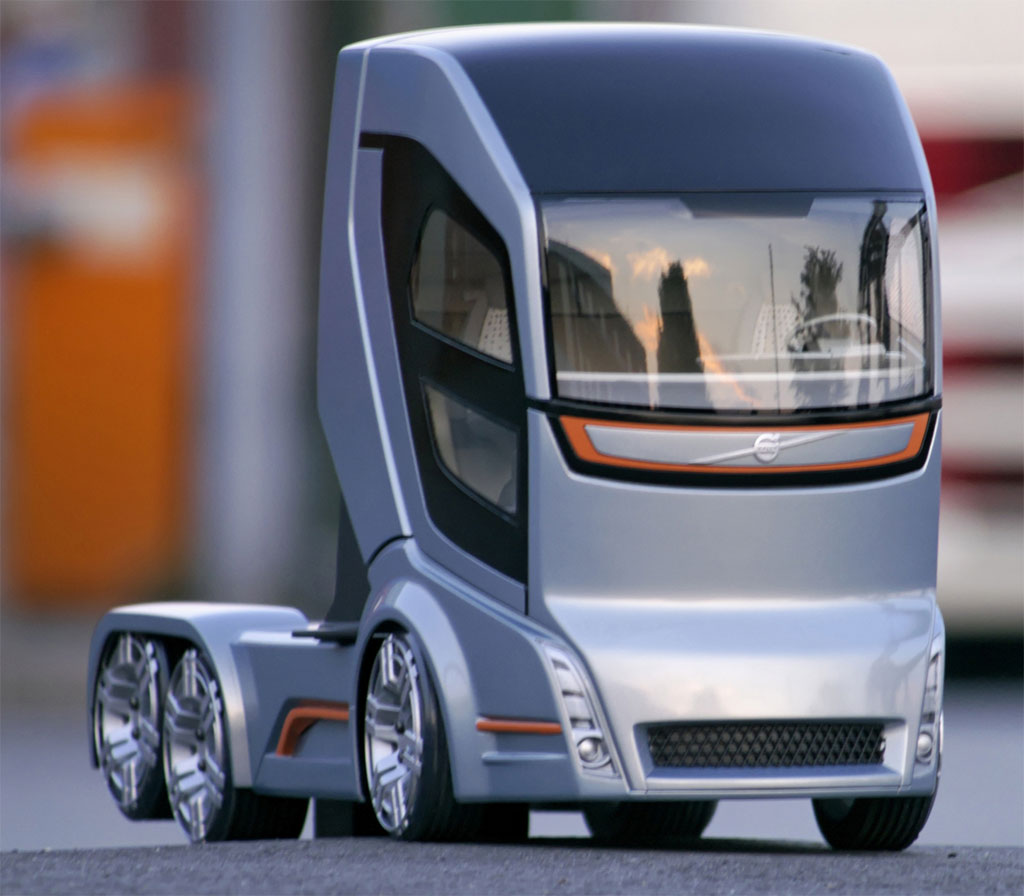
Volvo Concept Truck 2020

Swedish manufacturer Volvo Trucks recently unveiled the Volvo Concept Truck 2020 design concept, The Volvo Concept Truck 2020 displays a long distance vehicle, which can be combined in length, equipped with autopilot. The Volvo Concept Truck 2020 will be able to drive non-stop in nose-to-tail convoys that run at 90 km/h (56 mph) while the cars communicate with each other via a wireless connection.
Moving on to driver’s comfort, the driver’s seat looks more like a modern office chair with a thin ventilated mesh backrest. Behind the driver seat you will find a futon sofa which can be turned into a wide comfortable bed. The luxury experience is further complemented by the customizable lighting that can be changed as per in-cab tasks or resting. The driver may also control the privacy screening and blackout electronically.
Outside, the concept truck features LED headlamps and turn indicators that are integrated into the front of the vehicle. The rear-view mirrors have been replaced by cameras, while images are projected onto the inside of the windscreen.
The Concept Truck 2020 has rear-view cameras that project an image onto the inside of the windscreen and helps the driver to orientate better, LED headlamps and indicators, and collision protection panels on the truck's nose.
Press Release
TRUCKS OF THE FUTURE; CLOSER TO REALITY THAN YOU THINK
Progress is getting ever faster. In just ten years' time trucks are going to be a lot different to those of today. At least that is according to Rikard Orell, Design Director at Volvo Truck Corporation and one of the brains behind Concept Truck 2020, the Volvo Truck Corporation's bold vision for the future.
Long distance haulage for the future: long combinations, controlled by autopilot, driven non-stop in nose-to-tail convoys on green super-motorways linking the continents.
This is the vision of the future that generated the ideas behind the Volvo Concept Truck 2020 design concept. But will it really look like this in just ten years?
"That is the whole point," says Rikard Orell Design Director at Volvo Trucks. "Progress is getting ever faster. Because of this our vision for the future is not that far away. Much of the technology in the Volvo Concept Truck 2020 is already available; other technology needs to be developed. One needs to dare to stride firmly into the debate, demonstrating what one can and will do. Just tinkering at the edges runs the risk of progress slipping away."
Safer and more efficient commercial transport
As road transport expands it must also become safer and more efficient. Volvo's design concept contains ideas about how that can be achieved. Some of these ideas can be integrated into production today, while others are there to arouse interest and start a discussion.
One of the more startling ideas is to link vehicles together wirelessly into long road-trains that rush across the continents at 90 km/h (56 mph).
"This will be possible when the transport sector's vision of green corridors becomes reality," says Rikard Orell. "Here heavy goods vehicles are separated from other traffic, driving in their own lanes, rather like a railway, but without the rails."
There are many advantages. Road safety increases, transport services require less space and wear and tear on the roads decreases. Fuel consumption and CO2 emissions drop thanks to reduced drag when a truck is in the slipstream of the vehicle in front. In addition the driver can rest behind the wheel while the truck effectively drives itself. If this is counted as idle time, transport times can be cut, deliveries will be made more quickly and drivers can get back to their friends and families earlier.
Spacious and airy driver environment
The driver is at the centre of Volvo's world. It goes without saying that a design concept from Volvo Trucks contains a great many ideas about the development of the driver environment. In the Volvo Concept Truck 2020 the driver's environment is spacious, airy and free of disruption.
"We have replaced the traditional dashboard with a thin film panel on which information is tailored to suit the driver," says Rikard Orell. "The panel is operated like a touchpad, just like an iPhone. We have saved a lot of space that way."
Another space-saving idea is the sleek driver's seat with its thin, ventilated mesh backrest, more like a modern office chair than a traditional driver's seat. Behind the driver is a futon sofa which folds out into a wide, comfortable bed in the evening.
The lighting in the cab is divided into zones customised for the driver's various in-cab tasks, or for resting. Around the driver are large areas of glass providing good visibility out of the vehicle and even into it. This benefits eye contact between the driver and other road users preventing accidents. Privacy screening and blackout in the evening are also controlled electronically.
Aerodynamic collision protection
The design team also aimed for a sleek look for the exterior, reducing the perception of the vehicle's size. The LED headlamps and indicators are integrated into the front of the vehicle. The rear-view mirrors have been replaced by cameras that project their images onto the inside of the windscreen.
The lower section of the front of the vehicle features integrated collision protection projecting forwards about half a metre. This ‘nose' is gentler on oncoming cars in the event of a head-on collision and has also been shown to improve the aerodynamics of the vehicle.
As Rikard Orell points out, "Because the nose is a safety function, our starting point has been that it does not count as part of the maximum permitted vehicle length, just as rear-view mirrors today are outside the maximum permitted width."
Some things you just do not change. The ‘Globetrotter' sign on the roof is still there, but has been redesigned so that it harmonises with the lines of the vehicle and reduces drag. The driver can also change the text on the sign from the instrument panel.
The rear end is the next stage
So work on the external design focuses largely on aerodynamics, but by how much is it really possible to reduce drag on a truck ?
"We have come so far with the front of the vehicle that further changes to the basic shape provide only marginal improvements," says Rikard Orell. "However, a lot will happen when we start work on the design of the rear end of the vehicle. There is a great deal of untapped aerodynamic potential there."


